by Andrew Sammut
Published October 7, 2026
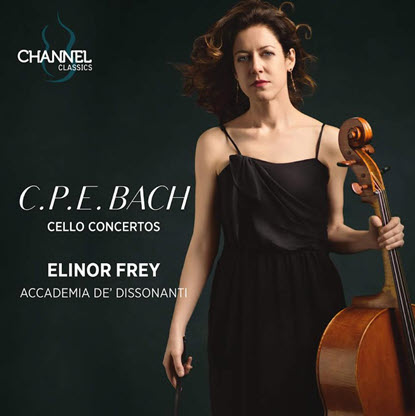
C.P.E. Bach: Cello Concertos. Elinor Frey, cello, and director, Accademia de’ Dissonanti. Channel Classics CCS50426
Besides the famous father, Carl Philipp Emanuel Bach is best known for composing some of the most avant-garde music of the second half of the 18th century. Haydn, Mozart, and Beethoven were all admirers. His music often packs rapid emotional shifts, unexpected dissonances, and angular phrases. Yet in his day job at the court of Frederick the Great, C.P.E. Bach could also create tuneful, formally simple pieces in the popular galant style. His cello concertos combine both these experimental and accessible sides.
The three concertos were probably performed at weekend concerts held by private music societies in Berlin, often featuring players from the royal orchestra although with music too jarring for the royal ears. Around the time of their composition (1750–53), the modern cello and concertos for the instrument were becoming more common, placing Bach’s advanced compositions and cello pieces at the cutting edge. His concertos put the soloist through the technical wringer and use the orchestra as more than just accompaniment.
It’s no surprise there are so many recordings of these concertos in the catalog, including multiple complete sets and HIP options. Montreal-based cellist Elinor Frey — profiled by EMA in 2024 — has recorded several albums of music by exceptional, if lesser-known, composers for the instrument. Directing her Accademia de’ Dissonanti ensemble, she now takes on these staples of the repertoire.
For Emanuel Bach’s concertos, Frey studied period ornamentation and melodic practice. She also investigated solfeggio technique used in instructional practice at the time. Her goal was to understand what a contemporary soloist might have brought to the score. Of course, using period practice to inform one’s playing today is essential to all HIP performers. But Frey’s approach seems motivated as much by her past colleagues’ feelings and presentation as by historical technique. That may explain, in part, why these interpretations stand out for their thoughtfulness and balance: a note-by-note sense of the craft behind these works and of the more personal context they premiered under, with the composer likely not just in the audience but perhaps guiding the soloist’s approach.
From the start, in the stormy first movement Allegro assai of the Concerto in A minor, subtleties of tone and rhythmic and dynamic flexibility mark Frey’s solos.
That attention to sheer sound highlights the vulnerability of her responses to the orchestra’s furious ritornellos. Frey’s direction and the Accademia’s responsiveness keep the contrast between soloist and ensemble well proportioned, neither exaggerated into Romantic excess nor smoothed into an overly formal Baroque stereotype. Frey’s choices also invigorate some of the borderline frothy parts of these works. The Allegretto of the Concerto in B-flat has a pleasant sing-song theme and neat phrases. Frey’s nimble ornaments and a slight edge to her tone keep things from getting too sweet, adding enough tension for self-awareness without slipping into parody or overwhelming the music’s scale.
As formally unconventional as he could be, Bach was nevertheless still writing concertos to show off a soloist. Frey burns through his virtuosic passages without them melting into flashy babble, like the fast runs of the final movement of the B-flat Concerto, articulated clearly and with personality. Slow movements are likewise beautiful and poised. The middle Largo of the Concerto in A Major shows off her pained upper register in a deeply somber atmosphere. The Adagio of the B-flat Concerto is a more stylized sadness, with clear melodic peaks well suited to Frey’s careful phrasing. She also adds a resonant and, at times, breathy tone and vocalistic inflections, including scoops and bends, illustrating personal touches rooted in historical knowledge.
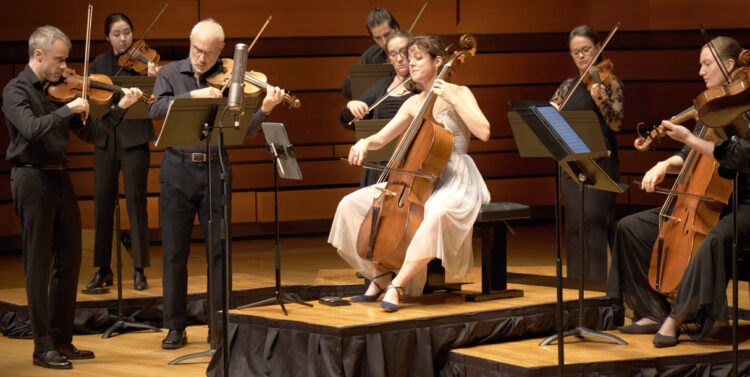
With strings (3-3-1-1-1) plus harpsichord, Accademia de’ Dissonanti reflects the ensemble size likely heard at these works’ premiere. More importantly, the group is nuanced and agile in its roles as countervoice and interlocking partner. In the third movement of the A-minor Concerto, Bach’s slurred down-and-up 16th-note figure, played lightning-fast but super clean and clear, becomes humorously defiant in their hands. The excitement builds further when Frey enters for pinpoint interactions with the ensemble, expanding into athletic, lighthearted playing that broadens briefly during the transitional section. The repeated 16th-note phrase in the final movement of the B-flat Concerto could easily become rococo filler. Here, it’s a propulsive and characterful refrain that really spurs the soloist.
There are more overtly visceral readings of these works, but Frey and Accademia de’ Dissonanti’s sensitivity and sense of scale get to their emotional core while zeroing in on fascinating musical details. This is a distinct and worthwhile addition to the discography.
Andrew Sammut covers music for Early Music America, the Syncopated Times, Vintage Jazz Mart, and his blog, the Pop of Yestercentury. He has also written for All About Jazz, Boston Classical Review, and Boston Musical Intelligencer. For EMA, he recently wrote about music fit for a teenage Bach.