by Andrew Sammut
Published October 5, 2026
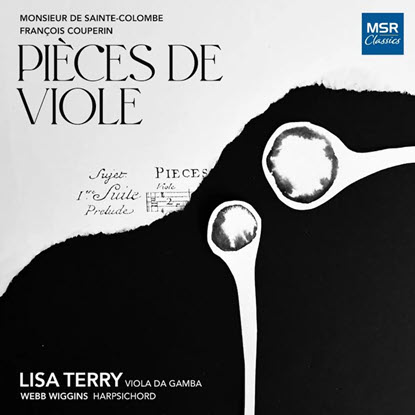
Pièces de viole: Monsieur de Sainte-Colombe and François Couperin. Lisa Terry, viola da gamba, and Webb Wiggins, harpsichord. MSR Classics MS1891
Fans of Philadelphia’s Tempesta di Mare will appreciate the ensemble’s principal cellist and gambist releasing a solo album. This is a concise but revealing introduction to Lisa Terry’s viola da gamba: three suites with ample technical and expressive opportunities that showcase a bold soloist.
The program centers on two contrasting voices of the French Baroque repertoire for the instrument. François Couperin (1668–1733) is well-known for his massive keyboard output. Couperin valued emotional directness over virtuosity and sought to integrate his native country’s graceful gestures and dances with Italian form and figuration. He was not a gamba specialist, but his music for the instrument became a staple of the literature. He brought his musical priorities to the gamba while leveraging the instrument’s unique sound and potential for techniques such as polyphony.
Monsieur de Sainte-Colombe (1640–92), the disc’s other composer, wrote exclusively for the gamba. Yet recordings of his music are less common than Couperin’s works, and historians know much less about his life. Among many other students, he taught Marin Marais, a seminal influence on French gamba music. Most of Sainte-Colombe’s roughly 250 surviving works are individual pieces for unaccompanied bass viol that combine improvisatory flair with arresting dissonances. This recital sequences four of Sainte-Colombe’s pieces into a suite alongside two suites from Couperin’s Pièces de Violes Avec La Basse Chiffrée.
Clearly defined rhythms and an extroverted feel distinguish Terry’s playing on this disc. Sainte-Colombe’s Ballet sways with a noticeable pulse despite the lack of any accompaniment. Her clean articulation adds a light but noticeable snap. There’s no loss of the subtlety and delicate gestures associated with the French musical language. It’s more like brighter strokes putting softer colors in greater relief. Without overpowering the gracefulness of the Fuguette from Couperin’s Suite No. 2 in A Major, the dotted figures achieve both lift and clarity. Flashier moments, like the arpeggiated runs in the Gavotte from Couperin’s Suite No. 1 in E Minor, and stretches of sheer beauty like the Sarabande, show confidence and attention to detail.
This disc may be one of the most hummable readings of this repertoire. Terry’s confident pacing and precise articulation — for example, in the Prelude from the Suite No. 2 — allow for well-shaped melodic figures throughout. Terry’s phrasing avoids the fussy, bunched feel of some other performances while still showing off the varied textural profile of her instrument, a seven-string bass viola da gamba by Peter Hütmannsberger of Linz, Austria, made in 2000.
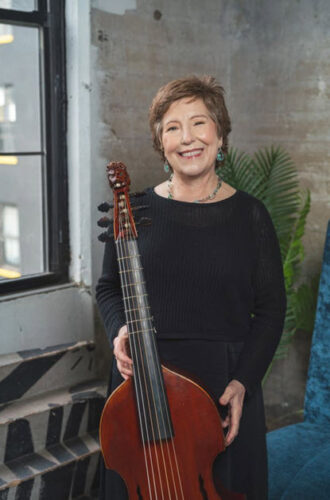
Attention to the gamba’s instrumental voice is obvious throughout this disc, starting with its first track, a charged Prelude by Sainte-Colombe delivered with seething, tense rhythms and strong attacks. Dolorous plunges into the gamba’s sandy low tones and gritty double stops twist into suddenly pained treble lines. In Couperin’s Pompe Funebre, her tightly controlled articulation makes the slightest register shifts and alternations between double stops and single notes come across like gamba duets. The movement’s title, along with its mournful melody and organ-like sustained chords, has led scholars to hypothesize that Couperin wrote it as a tribute after Marais’s death. Terry crafts an appropriately solemn memorial that isn’t afraid to cry out in the open.
Harpsichordist Webb Wiggins matches Terry’s energy and her rhythmic and melodic nuances. Imitative phrases feel like organic responses (rather than mere repetitions, as in some more understated performances). His sensitive touch lets Terry’s ornaments and timbral shadings come through even in thicker chords. Webb plays a harpsichord by Thomas and Barbara Wolf of The Plains, Virginia, based on a Parisian model by Nicolas Dumont from 1707. It’s lustrous but full, and its uniform sound across two manuals strikes the right balance between transparency and power. With its rich bass notes, most listeners probably won’t miss another gamba filling out the continuo.
A vivid recording in the University of Maryland’s Dekelboum Concert Hall keeps the gamba at the top of the mix, well suited to this earnest and refreshing but tasteful exploration of the music.
This disc also marks another recent single-instrument continuo recording in this genre, an artistic statement and, undoubtedly, a financial decision. EMA wrote about Caroline Nicholas’ album, which used a single theorbo for accompaniment. Obviously, a harpsichord’s volume and timbre produce a less intimate dynamic. On the other hand, it offers unique textural contrasts, especially when taking on melodic lines otherwise assigned to another gamba. Two solo debut recordings, sporting contrasting single-instrument continuos, released within months of each other: it’s a good time for gamba aficionados.
Andrew Sammut covers music for Early Music America, the Syncopated Times, Vintage Jazz Mart, and his blog, the Pop of Yestercentury. He has also written for All About Jazz, Boston Classical Review, and Boston Musical Intelligencer. For EMA, he recently wrote about music fit for a teenage Bach.