by Aaron Keebaugh
Published September 25, 2026
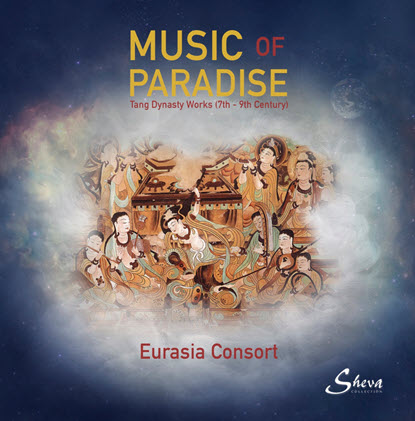
Music of Paradise: Tang Dynasty Works (7th-9th Century). Eurasia Consort, Sheva Collection SH340
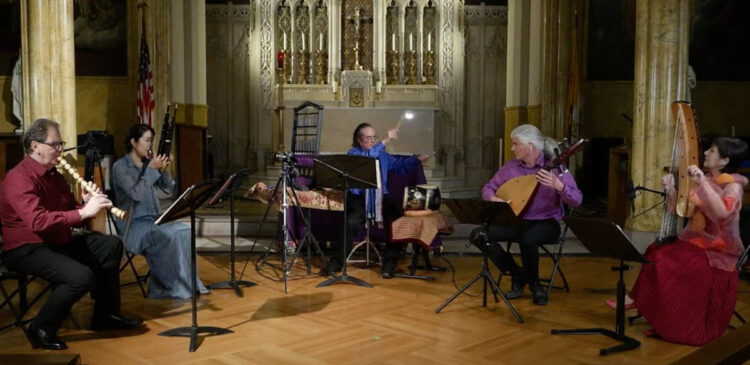
“We can’t have Europe at the center,” August Denhard of the Eurasia Consort told a Boston critic earlier this summer. Denhard’s mission, like that of the enterprising ensemble he co-directs, takes the widest possible view of musical history. With members based in both Seattle and New York, the Eurasia Consort has performed Western classics and commissioned works by contemporary composers for period instruments. But the heart of their work has seen them uncover, perform, and recreate the music of China’s Tang Dynasty.
Their recent efforts are collected on Music of Paradise, an exploration of folk songs and dances transcribed from music of Tang Dynasty courts. Taken together, the collection feels like an unbroken link to a past too often overlooked in the West. Bringing it to life has required the musicians to immerse themselves into just about everything from old manuscripts to the study of Chinese artwork from the 7th through the 9th centuries.
Denhard traveled to China in 2018 to study the music of the Tang Dynasty that had been preserved in the Dunhuang manuscripts, a vast collection of documents discovered in the Mogao Caves in 1900 but that were soon dispersed, via the antiquities trade, to Japan and the West. Coming face-to-face with the music brought Denhard into contact with Weiping Zhou, a professor at Shanghai University who commissioned the recreation of Tang-era instruments based on surviving models and study of Chinese iconography.
The Eurasia Consort, which performs on such models, brings these colorful sounds to vivid life. In many of the transcriptions on this disc, James Nyoraku Schlefer’s shakuhachi, a breathy end-blown flute, and Gamin’s piri, a bamboo oboe, carry much of the melodic line. Gamin also plays the seanghwang, a complicated Chinese harmonica that frames the sound with a silvery trim. Rhythmic figures from Denhard’s biwa, a lute plucked with what looks like a spatula, the harp-like kugo, played by Eurasia’s co-director Tomoko Sugawara, and haunting chimes from Rex Benincasa’s bell-toned hokyo inject vitality. (Disclosure: Denhard currently serves as vice president of EMA’s board of directors.)
The music plays upon varying shades of tone color through call and response. The Spring Warblers’ Song (transcribed by Laurence Picken) opens with Schlefer and Gamin trading bird-like chirps. Benincasa’s hokyo embellishes the phrases with isolated chimes before the rest of the ensemble joins in for sudden rush. Everyone plays the melodic line, though Denhard’s biwa interjects a few slashing pulses between cadential points. The effect is like viewing a precision-cut jewel in different shades of light: the musicians draw out every subtle curve and refraction of the line.
Similarly, the Waves of Kokonor (Picken) feels ambient and reverential. This central Asian folk dance took on new life in Chinese court music before spreading to Japan. It opens spaciously, with drums sounding out a series of propulsive taps. Denhard’s biwa then plucks out the melody against Schlefer’s mournful tones. Gamin’s seanghwang, Benincasa’s hokyo, and Sugawara’s kugo answer with ethereal sounds, the lines twisting into prismatic shapes.
Other pieces, like Butterfly Dance, ha and kyu (transcribed by Ye Dong) flicker with Terpsichorean zest. Here, Sugawara embellishes Benincasa’s melody with puckish flourishes. Gamin’s piri and Schlefer’s wispy phrases still allow the line to dance as the ensemble breaks into a kind of 7th-century jam session.
The musicians also play Tilted Cup Music (transcribed by Chen Yingshi) with toe-tapping energy. In the opening moments, subtle percussive rattles give way to the kugo’s steady figures as Schlefer’s line floats overhead. The music frequently dissolves into percussive washes only to crank up again with folk band verve.
Likewise, Palace of Congratulations (Picken) unfolds as a kind of play between opposites. Biwa and drums establish a sturdy pulse. Seanghwang and shakuhachi combine in wistful sonorities. Over that, kugo and piri tease out a majestic splendor.
Other works turn the spotlight on the soloists. In Yingfu (Chen), Benincasa’s hokyo rings like wind chimes, steady yet delicate. Kalavinka (Picken) progresses from hymnic serenity to whimsical serenity. Gamin’s piri sounds distant and mournful before the instruments join again in dialogue. Each takes a turn, though no one overpowers the other even as the music culminates in a vibrant flourish.
Prelude and Music of the Palace of Yue (Picken) sounds ambient by comparison. The seanghwang and shakuhachi join for eerie sonorities, the phrases unfolding at a glacial pace. Biwa and kugo then tease out a gentle rhythm. But here too, the musicians engage in a gleeful back and forth. Rather than taking turns in the limelight, these musicians revel in a camaraderie brought to fine point by grit and dedication. In the most emotionally centered paradise, these performances suggest, the work remains its own reward.
Aaron Keebaugh’s writing has been featured in The Musical Times, The Classical Review, The Boston Musical Intelligencer, BBC Radio 3, Total Baroque Magazine, and The Arts Fuse, for which he serves as regular Boston critic. For EMA, he recently described how the stars have aligned in Houston.