by Aaron Keebaugh
Published September 4, 2026
The beating heart of Harmonia Stellarum Houston: exploring music often relegated to the margins of music history
Their fifth season opens Sept. 13 with music by Mozart and a modern premiere from Luigi Gatti
This past May, a plane carrying a group of music-loving Texans touched down in Austria. Fans, musicians, and deep-pocketed supporters of Harmonia Stellarum Houston took a ten-day trek all over the country to explore historic organs and venues, like the Silver Chapel, in Innsbruck, and the renowned St. Florian Abbey. The voyage culminated in Vienna with a Harmonia performance. In this capital city paved with culture, the museums and historic dwellings and memorials painted a vivid picture of the composers that the ensemble is known for back home in Texas.
Their guide was Mario Aschauer, the Austrian-born conductor, organist, and musicologist who founded the enterprising band of period instrumentalists and singers four years ago. In that time, Harmonia Stellarum Houston has developed such a close rapport with their audiences and supporters that Aschauer routinely feels the stars align for performers and listeners alike.
“That was really a full immersion experience for the audience,” Aschauer said of the Austria trip during an interview with Early Music America. “Essentially, it’s a little bit like prolonging the full experience of the art that we are passionate about.”
That passion not only inspires Harmonia Stellarum to tackle familiar fare like Mozart’s Coronation Mass, which opens their 2026-27 season on Sept. 13, but also music by composers who have been all but lost to time.
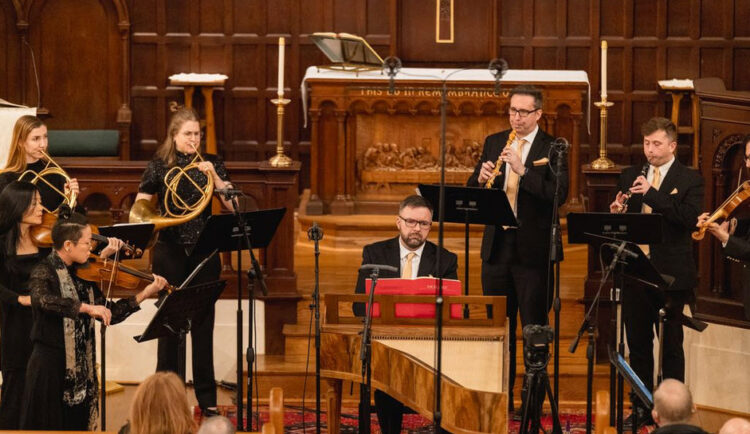
Music heard in the great court chapels of the Holy Roman Empire provides much of the impetus for the ensemble’s concerts. Harmonia routinely explores sacred and dramatic works composed for and by royalty. Last season, they presented music by Emperor Leopold I, who reigned from 1659-1705. This season includes Drama musicum, a 1640s opera composed by Ferdinand III, among the earliest surviving operatic works from the Habsburg court.
Other upcoming concerts explore the wider world of music that came out of the empire and northern Italy with monodies by Sigismondo d’India, keyboard works by Wagenseil, and sacred settings by Francesco Cavalli in a blend of Austrian gravitas and Italianate warmth.
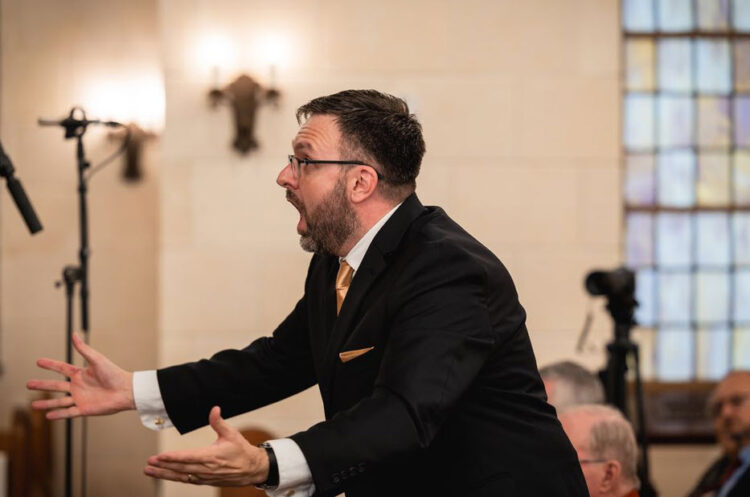
“I didn’t go into early music for Vivaldi, Handel, and Bach,” Aschauer said. “I wanted to do other things, and also wanted to do them more fully, on a higher qualitative level, and just with more dedication and passion.”
Many of Harmonia’s concerts present world premieres fresh from manuscripts Aschauer himself discovered on research trips abroad. Their recent trip to Austria brought Aschauer back into contact with the manuscript sources for Luigi Gatti’s Vespers of 1782, not performed in almost 250 years. Never published, the piece survives only in parts. Aschauer, an associate professor at Sam Houston State Univ. and who teaches harpsichord at Rice Univ.’s Shepherd School of Music, tasked himself with putting the work, in all its large forces, back together from scratch.
Composed for Salzburg, and scored for trumpets, horns, oboes, timpani, strings, and vocal soloists, Gatti’s Vespers was about as festive as one could get at the time.
“No one has been crazy enough to put the score together,” Aschauer joked. “At first, I thought we were going to do the whole Vespers. Then I realized this is way too long. I do want to do it in the coming seasons. But we’re going to do the first and last movements in our first concert on Sept. 13.”
Aschauer dug into the sources again when his former teacher at the University of Vienna discovered that the original score to Emperor Ferdinand III’s Drama Musicum lay dormant in the Library of Congress. The manuscript had been missing since the 19th century. The work, though, survived in critical editions, which Aschauer discovered were incomplete and riddled with errors. Harmonia will present the first performance of its own new edition of the opera based on the manuscript source.
These projects provide the beating heart of Harmonia’s efforts to explore music often relegated to the margins of music history.
“I don’t know if I perceive it as peripheral,” Aschauer said. “The longer that I’ve been doing this, the more that I’m convinced there’s very little bad music of the time. Typically, what happens is that if it doesn’t turn out great, it’s probably your fault. Because then you haven’t given it enough attention and enough passion.”
Such lofty goals are suggested by the ensemble’s name. It not only relates to the ancient notion of the Harmony of the Spheres but also refers to the choir of choirs: If the universe were musical, the old belief goes, this choir would consist of the harmony produced by the very stars.
The name stuck after Aschauer suggested it to the musicians. But it also reflected the continuous good fortune the group has had since its founding. Aschauer had taken a job as organist for the First Lutheran Church in Houston. With its wooden floors and high ceilings, the venue provided an ideal venue for early music just as Harmonia was taking flight. Then a generous donor enabled Aschauer to commission an Italian Renaissance-style organ for the ensemble’s performances. Brought to the church in April 2024, the organ was built by the Organi Famiglia Pradella in Caiolo, Italy. It is the first of its kind in Texas, with a Principale setting that perfectly suits the accompaniment of the ensemble’s voices, Aschauer said.
Quiet Time Concerts
Notably, almost all the musicians of Harmonia Stellarum fly to Houston from busy careers elsewhere. Much of that has to do with the unusual instrumental needs of early music, like the cornetto, sackbut, and viola da braccio, which are not abundant in southeast Texas. But the scene has started to crackle with energy and funding: Harmonia joins other Houston-area groups, including Ars Lyrica Houston, led by Matthew Dirst; Houston Early Music, a presenting organization with a five-concert season; Mercury Chamber Orchestra and La Speranza, two ensembles that perform Baroque and beyond; Les Touches viol consort; Bach Society Houston; and the newest, Ornamenti Baroque, which launched in 2025 and has four concerts scheduled for its 2026-27 season.
For his part, Aschauer hopes to build a steady roster of performers that can push the ensemble to new creative heights.
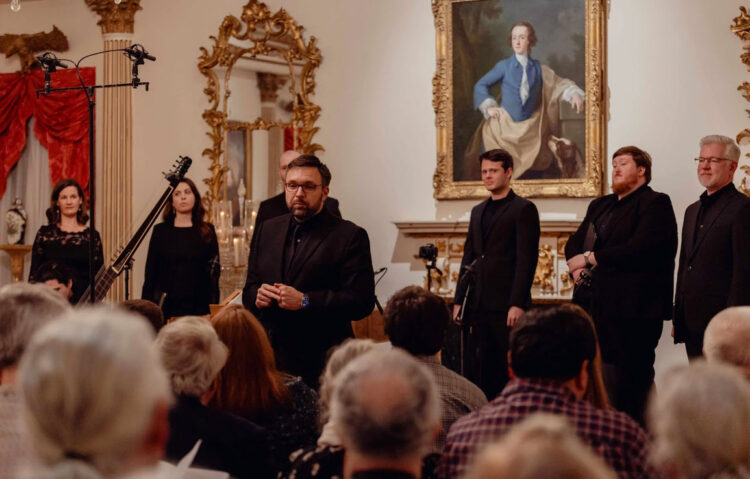
Elizabeth Tait joined Harmonia Stellarum in its early days. She is one of the few Houston-based singers on the regular roster. “Mario has sort of collected — like Pokemon — all of the artists that really are just up for the task of being really sensitive, collaborative music makers in the space,” she said. “We’ve developed a rapport with singers and instrumentalists from across the country that are more like core members.”
For Tait, there’s a simple formula to achieve the uniformity of sound that Harmonia Stellarum boasts: The director must be able to communicate their vision with the musicians, and most importantly, the musicians have to leave their egos out of the equation. “Mario’s just a textbook example of this,” Tait said. “He’s able to communicate in such a respectful way exactly how he wants it to be. But he also takes no prisoners: If you’re not doing the phrase in the way he’s envisioned, he will ensure that it does happen. It feels like a very safe and joyful place to rehearse.”
And if the performers are committed to the music, Aschauer says, the effect tends to be long-lasting. “If you give that same dedication, that same passion, to something that’s, at first sight, by a composer no one knows, I think the audience will pick up on that.”
Harmonia Stellarum is also developing an audience connection that goes beyond music. They’ve been giving seven concerts per season, often performed on Sunday afternoons from 4 to 5 p.m., usually a quiet time in Houston. An hour of music is followed by a reception for the 150 or so listeners, who have enabled the ensemble to start thriving financially.
The ensemble operated on a budget of around $120,000 last season. This season, Aschauer hopes to grow the budget to $150,000 — eventually hoping to bring that up to $300,000 a year, which would pay for concerts on Saturdays, Mondays, and performances elsewhere.
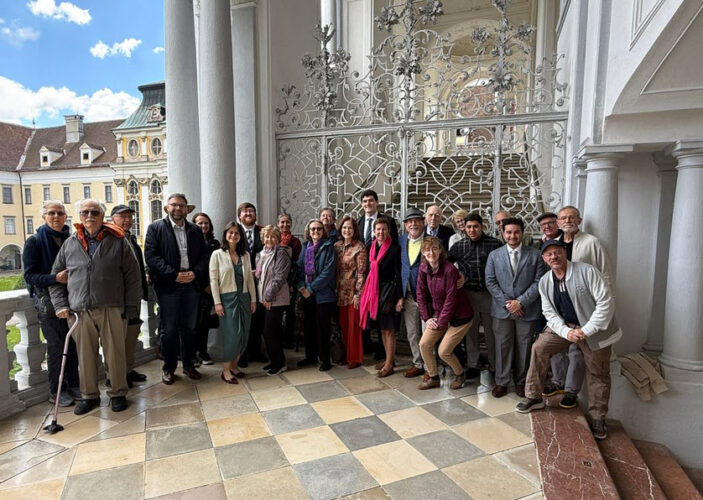
As with their programming, Harmonia sees financial investments as a way to deepen its relationship with its audience. The trip to Austria, which covered approximately $20,000 in expenses for five participating musicians, may not have netted a surplus for the organization this year. But Aschauer views the venture as step toward connecting further with its listeners and donors. And there are already requests for a similar trip in the future.
Harmonia also connects with its community in other ways. Their Christmas programs typically involve local high school choirs and audience members singing the chorales in sacred cantatas. This fall, the group will also launch HarmoniaTV, the ensemble’s streaming service to spread the word further about their work.
“Since we do so much for the first time, it would be really sad for this music to rot away in my Google Drive,” Aschauer said. In lieu of live-streaming, Harmonia TV presents the ensemble’s recorded concerts, helping preserve the performance for posterity.
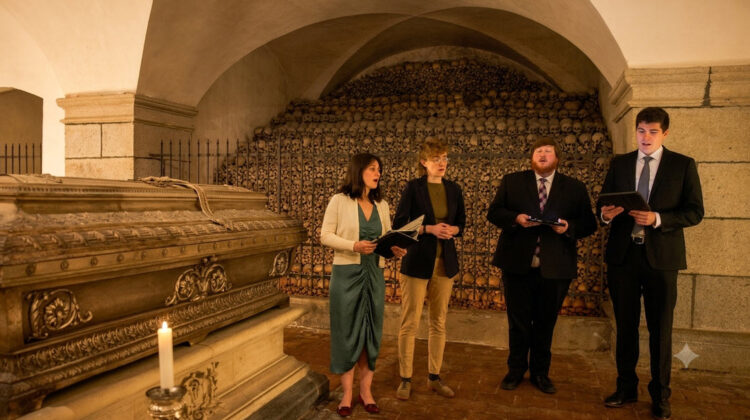
Videos on Harmonia Stellarum’s YouTube channel bring together sound and story. Along with clips of past performances, Aschauer presents short documentaries about madrigals, the role of the sepolcro at the Habsburg court, and the life and times of emperor-composers like Leopold, among others.
Meanwhile, Harmonia has found new ways to get the music from the page to the stage. Aschauer has founded a small publishing business, Harmonia Stellarum Editions, that aims to publish newly edited versions of the works he finds lying on archival shelves.
These combined efforts show an ensemble on the move and reaching for its eponymous stars. But its success remains grounded in the music as a source for new discoveries.
“I do see myself, in a way, as a priest of the artwork,” Aschauer said. “But at the same time, that doesn’t only mean that you read the gospel, and that’s it. Everything I do and all the effort that I put into it is really trying to figure out the message that it’s trying to convey and then putting it into a reality that others can perceive in 2026.”
“I’m just a nurturer. I really enjoy digging into problems like that, because it’s like discovering a new planet.”
Aaron Keebaugh’s work has been featured in The Musical Times, The Classical Review, The Boston Musical Intelligencer, BBC Radio 3, Total Baroque Magazine, and The Arts Fuse, for which he serves as regular Boston critic. For EMA, he recently reviewed Music to Accompany the Canterbury Tales.