by Alon Schab
Published October 12, 2026
Christian Music in Jerusalem: The First Two Thousand Years by Alexander Rosenblatt. Jenny Stanford/Routledge, 2025. 134 pages.
In the fourth chapter of his book, Israeli ethnomusicologist Alexander Rosenblatt quotes the Rev. Fanous of the Immanuel Evangelical Church in Ramle (about 10 miles from the Tel Aviv Airport), who observes: “In Africa […] they have the courage to bring dance to the church. We do not have such courage to bring our culture into religious experiences.” The very idea of a conflict between one’s own culture and one’s own religious experiences must sound disturbing to many, yet this is but one of the many tensions that underlie this fascinating study of Christian music in Israel.
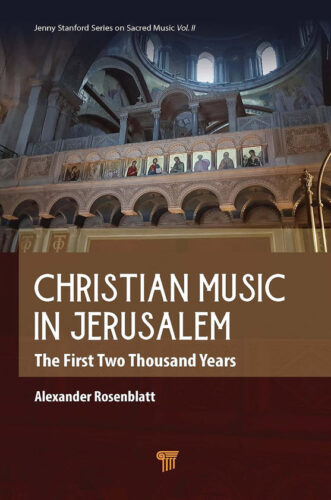
Despite its title, Christian Music in Jerusalem actually covers a somewhat broader geographical area, including the north and center of modern-day Israel. The book can be seen as a much-needed introduction to Christian music in the Holy Land, a subject that has remained largely shrouded in obscurity. Just as the great masters of historical painting have had to use their imaginations to depict Bethlehem, the Jordan River, the Sea of Galilee, or Solomon’s Temple, so Christian music in Judea, the Kingdom of Jerusalem (and the many other names of this land) has often been something of a historical blank into which we project our own preconceptions. Rosenblatt helps to dispel some of this fog through an ethnomusicological examination of traditions that continue to exist in the Holy Land today.
The first chapter addresses early Christian singing — a field that is, by definition, largely hypothetical. Indeed, the further back we go, the more the investigation of early religious song becomes relevant not only to Christians but also to Jews. Rosenblatt’s brief discussion of biblical musical instruments is useful. His interesting assertion is that some pre-Christian Greek hymns, “when performed in reconstructed form by an ensemble trained in Byzantine music, sounds exactly like early church music.” The idea that this music can sound a certain way when performed according to a particular performance practice is a fascinating one (and especially relevant for the readership of this review) — and presumably derives in part from Rosenblatt’s own experience as a seasoned performer of early music. Rosenblatt responsibly refuses to conclude whether this tradition passed from the ancient Greeks to early Christian music, and “bypassed” the Temple of Jerusalem. Indeed, if Christian music developed directly from Greek music, this would complicate the book’s discussion of a shared origin for Jewish and Christian music.
The instability of the historical ground becomes even more apparent in attempts to create precise chronologies, such as the dating of the establishment of the “first of the Jerusalem and Christian churches in general” to 33 CE. Rosenblatt’s curiosity about the very early history of Christian music resurfaces elsewhere in the book, as in Chapter 5, where he advances “the idea that Syriac church music, which is one of the ancient sources of Christian music, is associated not only with Byzantine, Roman Catholic, Armenian, and Georgian rites, but probably stems from the music of Jerusalem rite, if not from the Second Temple”. Rosenblatt nevertheless succeeds in keeping these questions somewhat in the background, using them to indicate the possible implications of his research for historical narratives without falling into their methodological traps.
Chapter 2 provides an important overview of the various Christian denominations and churches in Israel, their legal status, and, most importantly, the corpus of recordings of Christian liturgy from the Holy Land. The tradition that lies at the center of Rosenblatt’s research, and for which he provides the most extensive background, is the Arab-Anglican tradition.
Although Chapter 3 is, in essence, a literature review, it is a fascinating one. It begins with a critical reading of the seminal work of Dalia Cohen (1926–2013), examining it from a refreshing anthropological perspective that, as Rosenblatt acknowledges, was hardly possible when Cohen conducted her research in the 1960s. He then turns to the work of other Israeli ethnomusicologists, and finally surveys scholarship produced by authors outside Israel. Here, too, the critical perspective is valuable, addressing, among other things, the ways in which the political complexities of the Israeli-Palestinian conflict complicate research, even raising the hope that this book might succeed in rising above those complexities.
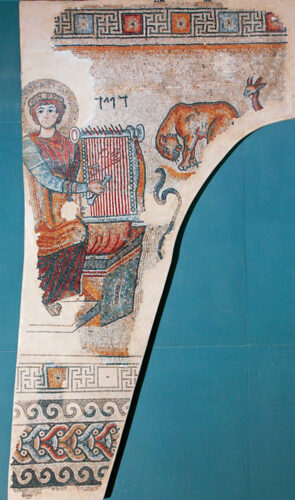
The second part of the book, “Insights and Reflections,” represents the core of Rosenblatt’s contribution. Chapter 4 describes musical practices in post-missionary churches — a term referring to churches in which “the contemporary/independent (‘Post’) component of the church service is worship songs and other paraliturgical music.” The chapter begins with a discussion of hymnals. Here again, Rosenblatt’s attempt to trace the complex processes that produced changes in the major/minor balance of local hymnals is intriguing. He explains how the adoption of minor-key hymns by communities accustomed to maqāmāt such as Navah and Hijaz was presumably more problematic than the adoption of major-key hymns, which were sung in Ajam, a maqām whose sound is closer to that of Western tonality. The implications of these observations for anyone involved in early music who seeks inspiration from Middle Eastern musical traditions are not difficult to discern.
This chapter moves beyond hymnals to describe both the structure of liturgy in the various Anglican churches in Israel and the realm of paraliturgical music. Rosenblatt describes the Arab-Anglican “song system” and the music performed at community summer camps, as well as the tension between borrowed songs of Lebanese origin and those of Egyptian origin.
Chapter 5 turns to the Maronite and Orthodox and Greek Catholic (Melkite) churches. Here, the available materials allow for a comparative approach, whether between recent recordings and older ones preserved in the National Sound Archive, or between recordings of Maronite communities in Israel and those of Maronites abroad. The historical background of the Maronites is presented engagingly, and it is fascinating to see how processes of Westernization and, conversely, processes of rapprochement with Arabic music emerge from circumstances different from those discussed in Chapter 4. The section on the Orthodox and Greek Catholic traditions is more modest in scope, but nevertheless intriguing in its fresh approach to the motivations behind the shift from one modal system to another.
Rosenblatt’s insight about the ability to reconstruct the ancient sounds of Maronite tradition by “reversing” processes of later adaptation into Western tonality is bound to stimulate the imagination of anyone interested in historical performance and musical transmission.
The background to Chapter 6 is somewhat surprising. Christian-Jewish dialogue in the formation of a renewed Jewish religious music has occupied scholars for more than a century. However, the ethnomusicological perspective through which he examines the music of modern Israel is both interesting and novel. His knowledge of the inventory of historical keyboard instruments in Israel is second to none.
I believe that the history of early music in Israel deserves a study of its own, and that it is impossible to survey the field without discussing the two Baroque orchestras, as well as the various ensembles that have been active at different periods. At the same time, any future study of the subject will need to take into account Rosenblatt’s brief history of keyboard instruments in Israel — including the harpsichord builders who lived, albeit temporarily, in Mandatory Palestine — as well as other areas in which his personal participation makes him an invaluable informant. Rosenblatt’s discussion of contemporary Israeli concert music on Christian texts is similarly innovative and deserves a more extensive treatment.
All in all, this is a highly readable book, written in fluent prose and, at times, even with a sense of humor, especially in the thought-provoking conclusion. For anyone interested in early music, it provides an essential ethnomusicological background for artistic or scholarly engagement with one of the most fascinating and historically and culturally rich geographical regions in the world.
Prof. Alon Schab is a musicologist at Bar-Ilan University. He has written extensively on 17th-century music and historically informed performance. In recent years, his research has focused increasingly on music in Palestine and Israel during the British Mandate period.