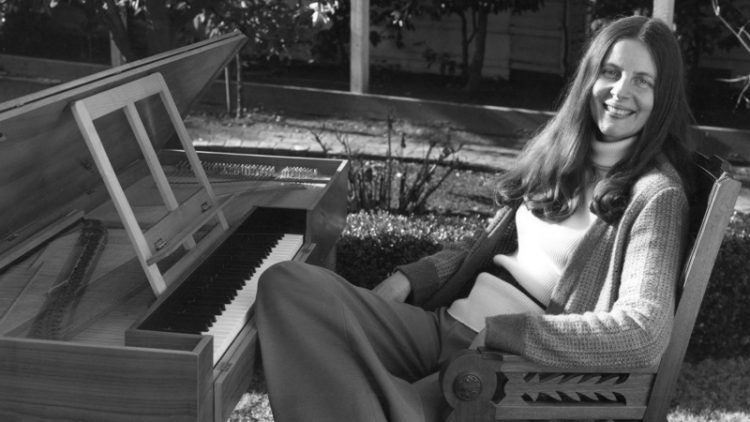
Joan Benson (1925-2020)
Read More:
Joan Benson: Clavichord Champion, published by Early Music America in April 2018
2019 Review of The Joan Benson Collection: Clavichord and Fortepiano
The Joan Benson Clavichord Award, launched in 2021, is an annual award for a current outstanding American clavichord artist, teacher, researcher, composer, clavichord maker or organizer of clavichord symposiums, master classes or sessions for children. The intention is to show the significance of soft, tender tones through the clavichord. The awardee will have awakened a vivid appreciation for this delicate keyboard instrument and shown its unique ability to express music through delicate, dynamic-rich, highly-nuanced sounds.
The distinguished keyboardist Joan Benson died on January 1, 2020, aged 94. She studied with Percy Grainger at Interlochen before traveling to Europe, where she worked with Edwin Fischer and Olivier Messiaen. In the second half of her life, she taught at Stanford and the University of Oregon and was one of the early proponents of the works of C.P.E. Bach.
A voluntary selection committee nominated by Joan Benson will choose the recipient of the Joan Benson Clavichord Award. Their decision is final.
Previous Recipients
2025: Joel Speerstra
2024: Paul Irvin
2023: Alissa Duryee
2022: Carol lei Breckenridge
2021: Anna Maria McElwain
2026 Recipient: John Koster

John Koster, born in upstate New York in 1950, has been involved with music, especially early music, since he was a boy chorister attending St. Thomas Choir School in Manhattan. He was introduced to historical musicology at Harvard College, where he earned the A.B. with Honors in Music for his thesis on musica ficta in the fifteenth century. Active for many years as a maker and restorer of harpsichords and other early stringed keyboards, he worked closely with the instrument collection at the Boston Museum of Fine Arts. After a year as research fellow at The Metropolitan Museum of Art (New York), he was Professor of Music, Conservator, and Curator at the National Music Museum, University of South Dakota, from 1991 to 2015, when he returned to New England. He is the author of Keyboard Musical Instruments in the Museum of Fine Arts, Boston (1994) and of many articles on the history and use of musical instruments, especially early keyboards, and their contexts in society, art, and technology. His work has been recognized by the American Musical Instrument Society with its Bessaraboff and Densmore Prizes for publications, as well as by the 2016 Curt Sachs Award for lifetime achievement.
It is indeed a great honor to receive the Joan Benson Clavichord Award. The clavichord has been an important part of my musical and scholarly life since 1964, when my father and I constructed an instrument from the earliest model of Zuckermann kits. For some years this modest instrument served as the medium through which I began to explore the riches of early keyboard music, from Sweelinck and the English virginalists, through Frescobaldi and Froberger, to Bach and Handel. For two decades I worked closely with the musical instrument collection at the Boston Museum Fine Arts, which included three historical clavichords. There I had the pleasure of meeting and working with Joan Benson on a number of occasions when I oversaw instruments on which she performed and recorded.
My principal contribution to the rarified world of the clavichord, I believe, has been in research and the resulting publications. Many of them concern the origins and early history of the instrument in the late fourteenth and fifteenth centuries. Others concern technical matters, particularly stringing, pitch, and their relationship, along with other elements of design, to the touch and sensitivity of the action. Also, during my curatorship of the keyboard collection at the National Music Museum, I was fortunately able to facilitate the acquisition of three historical clavichords.
Throughout my life I have been privileged to have known and collaborated with such pioneers of performing on, researching, and making clavichords as Joan Benson, Edwin Ripin, Bernard Brauchli, and Hugh Gough. My deepest thanks to them for their example and help, and to Early Music America for this award, which I accept with humility and pride.
– John Koster
John Koster’s publications principally about clavichords
“The Clavichord in the Netherlands before Henric Arentss van Zwolle,” Clavichord International 12, no. 1 (May 2008), pp. 6-19.
“Clavichord and Clavecimbel in Dutch Society, fifteenth-seventeenth Century,” Clavichord International 12, no. 1 (May 2008), pp. 24-34.
“New Sources for the Early History of the Clavichord,” Early Keyboard Journal 20 (2002), pp. 7-43; also a postscript in Early Keyboard Journal 21 (2003), p. 139.
“Cathedrals, Cabinetmaking, and Clavichords,” Clavichord International 4, no. 1 (May 2000), pp. 6-13; no. 2 (November 2000), pp. 40-47; and 5, no. 1 (May 2001), pp. 6-13.
“The ‘Still, Small Voice’ and the Exploration of Inner Musical Space,” in De Clavicordio: Atti del Congresso Internazionale sul Clavicordo, Magnano, 1995, edited by Bernard Brauchli, et al. (Turin: Istituto per i Beni Musicale in Piemonte, 1996), pp. 155-165.
“The Stringing and Pitches of Historical Clavichords,” in De Clavicordio: Atti del Congresso Internazionale sul Clavicordo, Magnano, 1993, edited by Bernard & Susan Brauchli and Alberto Galazzo (Turin: Istituto per i Beni Musicale in Piemonte, 1994), pp. 225-243.
“List Gets Shorter as Rare Swedish Clavichord is Found,” America’s Shrine to Music Museum Newsletter 27, no. 4 (November 2000), pp. 1-2.
“Keyboard Instruments Traced Back to 16th-Century Naples,” The Shrine to Music Museum Newsletter 23, no. 1 (October 1995), pp. 1-3.
Technical Drawings of a Clavichord by J.C.G. Schiedmayer, Neustadt an der Aisch, Germany, 1796 (Boston: Museum of Fine Arts, Collection of Musical Instruments, 1985).
Publications partly about clavichords
Keyboard Musical Instruments in the Museum of Fine Arts, Boston (Boston: Museum of Fine Arts, 1994; also published under the imprint of Northeastern University Press, Boston).
“From Fimbria to Clavisimbalum: The Genesis of Henry Arnault’s Harpsichord Plan,” Informazione Organistica e Organologica, terze serie, no. 2 (anno 33, n. 48; 2021), pp. 35–73.
“The Early Neapolitan School of Harpsichord Making,” in Domenico Scarlatti en España / Domenico Scarlatti in Spain, Luisa Morales, ed. (Garrucha, Almería, Spain: Asociación Cultural LEAL, 2009), pp. 47-80.