by Jeffrey Baxter
Published October 25, 2026
Bach: Mass in B minor Apollo’s Fire and Apollo’s Singers, conducted by Jeannette Sorrell, with soprano Rebecca Myers, mezzo-soprano Aryssa Leigh Burrs, contralto Emily Marvosh, tenor Jacob Perry, baritone Edward Vogel, and bass-baritone Paul Max Tipton. Avie Records AV2850
What could have easily been a scholarly exercise instead proves to be possibly the best available small-sized period-instrument recording of the B-minor Mass
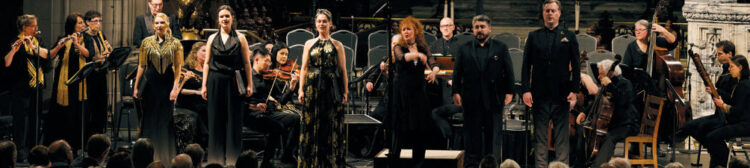
In a procession of notable Bach B-minor Mass recordings over the past two years — including Nicholas McGegan’s intimate Cantata Collective reading and Raphaël Pichon’s choral extravaganza with Pygmalion — Jeannette Sorrell and her skilled ensemble, Apollo’s Fire, have struck what may be the perfect balance, leading the way with this exceptional 2026 release.
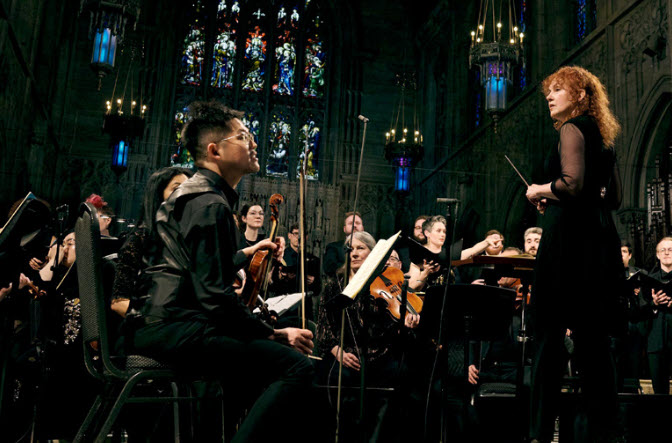
For this recording, Sorrell uses a chorus of 22, roughly four-to-a-part in the Mass’ many SSATB movements. As the conductor and keyboardist says in the liner notes, this corresponds to the desired chorus size that Bach famously requested of the Leipzig Town Council in his 1730 “Entwurf.” She also points out that the larger 35-member French-sized ensembles of that time — about the size of Pygmalion’s 2025 recording — is not what Bach requested and does not ultimately serve his purposes.
As for the orchestra, Sorrell has balanced the vocal forces with an instrumental ensemble of 12 strings [4-3-2-2-1] and solo winds, brass, timpani, and organ — all playing with a blazing individual virtuosity that remains in full service to the whole.
What could have easily devolved into a scholarly (or underpowered) exercise instead proves to be possibly the best available small-sized period-instrument recording of the B-minor Mass thanks, in large part, to Sorrell’s carefully guided vision of Bach’s concept of the Mass setting as a whole — the Missa tota — with nothing amiss: correct choices of tempi, balances of orchestra, chorus, and solo voices. This is all enabled (and not artificially enhanced) by careful engineering overseen by talented record producer Erica Brenner.
Sorrell’s performance is delivered mostly purely choral throughout, except for two crucial portions where concerto grosso principles of solo vs. tutti are applied: in the fugal exposition of “Et in terra pax” (with its beautifully exciting build to the timpani-punctuated final cadence) and the opening of the stile antico motet-movement, “Credo in unum Deum.”
In the Mass’ opening declamation of “Kyrie eleison,” Apollo’s Singers (eschewing a Germanized Latin pronunciation) grip the listener with a unified compelling forte, despite their small forces. Their impassioned cry is followed by vocally clean but always energized fugal lines that shape Bach’s masterfully controlled writing. They create a musical intimacy without losing support or immediacy. Individual voices are both strong and well-matched, allowing for power and flexibility without any one voice intruding into the texture.
Like McGegan’s 2024 recording, Sorrell deploys a quintet of solo voices for “Credo in unum Deum” (but only at the first five fugal entries), then tutti to finish with the long cantus firmus augmentations. The same technique is applied, if only momentarily, in the opening measures of “Patrem omnipotentem,” which Sorrell begins with solo voices before quickly inserting the tutti chorus for the rest of the movement — perhaps echoing a liturgical effect of “call and response.”
This recording also features a superb selection of six vocal soloists, all equally gifted and suited to each aria or duet but also able to lead anonymously in the choral passages. It is a pleasure to hear a tonal difference between the two sopranos, one high and flute-like, the other more mezzo (although an oddly mannered final cadential pause in the solo violin of the Soprano II aria, “Laudamus te,” seems uncharacteristically imposed).
It is also a wonderful luxury to have two solo bass voices, one for the sonorous “Quoniam tu solus sanctus” (Paul Max Tipton) and one for the more baritonal “Et in spiritum Sanctum” (Edward Vogel). The only real flaw among the six soloists is an obtrusive quick vibrato in contralto Emily Marvosh’s rendition of “Agnus Dei” that disturbs her otherwise excellent breath control and spun legato.
The flute solos of Apollo Fire’s Kathie Stewart shine in “Domine Deus” and “Benedictus,” and it is a welcome moment to experience so clearly the undulating canonic duo of flutes — expertly performed by Stewart and Amy Guitry — set against the smooth sustained vocal lines in “Qui tollis peccata mundi.”
Because Bach designated a different number of voices for the Credo’s three central choral movements (“Et incarnatus est,” “Crucifixus,” and “Et resurrexit” — voiced à 5, à 4, à 5 respectively), some conductors allocate a contrasting solo quartet for what is the Mass’s moving centerpiece, its Golden Mean. Fortunately, Sorrell employs her choral forces for all three movements to great effect, with heavenly pure legato lines of “Et incarnatus est,” followed by the striking martellato of earthly pain in “Crucifixus” that then explodes in joy at “Et resurrexit.” They create a strong contrast that does not forsake vocal unanimity.
Interestingly, while “Et resurrexit” is sung by the full choral forces throughout, Sorrell does employ a solo bass voice (Edward Vogel) to unfurl the florid phrase “et iterum venturus est.”
In the liner notes, Sorrell confesses her youthful intimidation of Bach’s summa opus and how she hesitated decades before undertaking any performances. This exceptional recording proves that the time was right, as she has delivered what is surely one the very best representations of Bach’s masterpiece, with an ideal combination of technique and spirit and experience that stands as testament to the composer’s mastery and humanity.
Jeffrey Baxter is a retired choral administrator of the Atlanta Symphony Orchestra, where he managed and sang in its all-volunteer chorus and was an assistant to Robert Shaw. He holds a doctorate in choral music from The College-Conservatory of Music of the University of Cincinnati and has written for BACH – the Journal of the Riemenschneider Bach Institute, the Choral Journal, and ArtsATL.org. For Early Music America, he recently reviewed Bach’s St. John Passion from Pygmalion.