by Karen M. Cook
Published November 1, 2026
La Nobiltà di Milano: Music from the City of the Spanish Viceroys. The Breathtaking Collective & Cappella Mariana, Bruce Dickey, cornetto & artistic direction. Passacaille PAS1172, 72:10
Habsburg Milan has, unfortunately, remained in the shadows of neighboring cities such as Venice and Florence. Hit by two terrible bouts of plague and forced to accept foreign rule under the Spanish King Philip II, Milan nevertheless flourished artistically in ways that have sometimes escaped the modern ear. Motets and madrigals were certainly cultivated genres in 17th-century Milan, but instrumental genres had particular pride of place, especially the ensemble canzona. One uniquely Milanese genre is the canzon-mottetto: a hybrid work that at first alternates, then later combines, an a cappella motet with an instrumental canzona until it becomes essentially a double-choir motet in which one choir sings, the other plays.
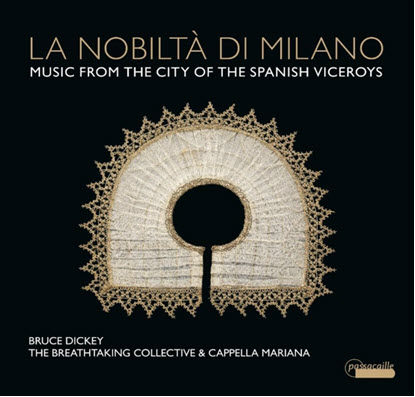
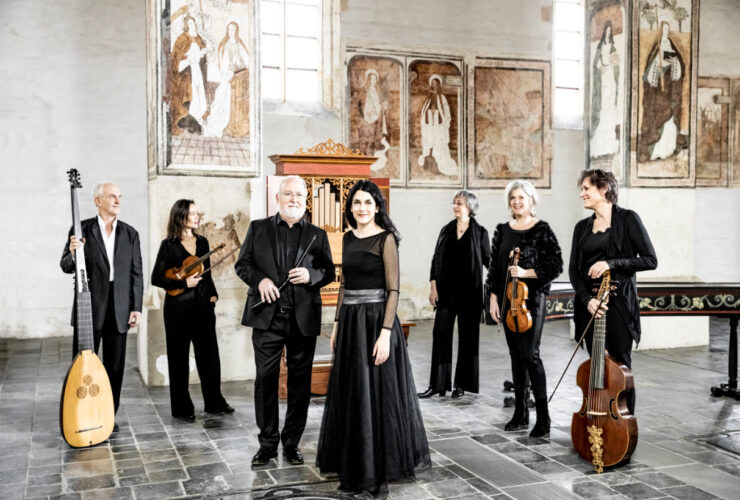
All of these works form the backbone of this new release by Cappella Mariana, a Prague-based vocal ensemble, and the Breathtaking Collective, a project founded by Bruce Dickey, an American cornetto player, and Hana Blažíková, a Czech soprano, to explore the affinity of the cornetto and the human voice.
The album is a tourist’s dream, taking the listener through the various churches, courts, and convents that made up Milan at the turn of the 17th century. It opens with one of the album’s three motets: Assumpta est Maria by Giovanni Paulo Cima, organist at S. Celso until his death in the 1630 plague. From here, the album nicely shifts from genre to genre, alternating between vocal styles and instrumental works.
Francesco Ragnoni Taeggio’s canzon-mottetto O Rex Gloriae really shows off the ensemble’s rich, warm voices and their great sense of building toward pivotal moments, and we can hear the composer’s delightfully crunchy harmonic tendencies, which will protrude even more in the two groups of his madrigals that follow later on. For me, the first grouping of madrigals is the most appealing; they’re fresh and exciting from the jump, the first (“Intenerite voi lagrime mie”) really capturing that shift toward the seconda prattica. They feel, in some ways, like the heart of the album.
There is a bit of a family affair in this music: another Cima, brother Andrea, shines on an instrumental Capriccio, and then Francesco’s brother, Giovanni Domenico Rognoni Taeggio, follows with his own canzon-mottetto, Quemadmodum desiderat. Somewhat reminiscent of Palestrina, this piece has one of the better vocal openings on the album; it’s a real standout. So too is the canzon-mottetto Ipse sum desponsata, by Agostino Soderini, with its sense of verve and some of the album’s loveliest cornetto lines. The brass ensemble is in full force throughout, though; listen to Giovanni Domenico Rognoni’s canzon La Niguarda for another great example. And it would be remiss of me not to mention the sparkly, vivacious violin playing by Veronika Skuplik, which is at its best on the ornamented version of Palestrina’s “Vestiva i colli.”
Overall, it’s a new and yet familiar soundworld to explore—not just a wonderful first exposure to so many lesser-known composers and genres, but an entertaining and enriching musical experience. I would love to hear them revisit even more of this material on a future recording. After all, the vivid liner notes tell us that it was Andrea Cima who published the first instrumental pieces to be called “sonata,” so a sequel starting with those works would be rewarding indeed. Highly recommended.
Karen M. Cook is associate professor of music history at the University of Hartford. She specializes in late-medieval music theory and notation, focusing on developments in rhythmic duration. She also maintains a primary interest in musical medievalism in contemporary media, particularly video games. For EMA, she recently reviewed Josquin from Jesse Rodin and Cut Circle.