by Parker Ramsay
Published November 3, 2026
Byrd in Italy: An Imagined Journey, Freddie James, organ and harpsichord. Passacaille PAS 1176
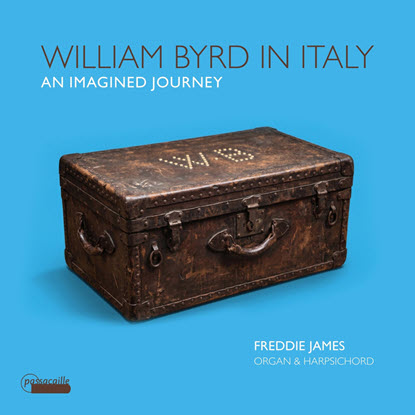
In the world of early-music recordings, we’re increasingly comfortable moving beyond the guesswork and instead jockeying with ideas of plausibility. With Elizabethan organ music, however, we’ve no extant instruments on which to work. Many of our ideas about what to do with the music come down to conjectures of style. Of course, it’s one thing to read about a composer and say he was influenced by x composer from y place. William Byrd, for example, was influenced not only by Italian madrigals and sacred choral music, but also by the colorful keyboard music from Venice. But how far are we willing to go to showcase such influence when Byrd himself never set foot in Italy (let alone off British soil)?
For British organist and harpsichordist Freddie James, now based in Switzerland, there’s no question. His new album Byrd in Italy: An Imagined Journey (released on Passacaille in September) commences by taking a Prelude and Fantasia from the Fitzwilliam Virginal Book to the Vincenzo Colombi organ in Valvasone, constructed in 1532. The only surviving instrument of the Venetian school from the 1500s, the instrument’s simultaneous depth and clarity lend themselves well to the density of Byrd’s various fantasias.
The effect is nothing short of hair-raising, if not only to provide a refreshing counter-narrative to customary anemic performances on chamber organs (see: “Twee”), or oversized Northern European instruments, whose heavy actions don’t lend themselves readily to nimble passage-work across the keyboard’s compass.
But no sooner do we have Byrd’s new sound in our ears than we move to the music of Girolamo Frescobaldi. The second Corrente from Frescobaldi’s Libro Primo offers a light palate cleanser, showcasing the instrument’s suitability for dance music. James’ customary feather-light touch at the keyboard has a rhythmic vivacity that serves to remind us that organ music of this period was not limited to somber large-scale toccatas, but to repetitive kinetic forms that highlight the Renaissance’s penchant for variation. Byrd’s Qui Passe (from My Lady Nevell’s Virginial Book) uses a single flute stop, which proves to be just as clear and articulate as the larger registrations employed in the preceding tracks.
If there’s one bait-and-switch on the album, it’s the unexpected delight of being exposed to a Recercada of Claudio Veggio. Despite my own love for early Italian music, I will admit to falling prey to knee-jerk assumptions about the music’s seemingly pedestrian quality on paper. Brought to life in mean-tone temperament by a performer with an incredible sense of verve and levity, rhetorical figurations and harmonic procedures become wonderfully expressive twists and turns. Byrd is the star of the album, but Veggio (at least for me) is the showstopper.
We return to another fantasia by William Byrd, but this time at an Italian harpsichord, a copy of an instrument in the Royal College of Music Museum in London by the Venetian builder Alessandro Trasuntino in 1531, made by Tony Chinnery in Tuscany in 2023. Just as the wind pressure is light on Italian organs of this period, so the stringing is light on the harpsichords, offering a certain sparkle to the transparency. In James’ rendition of the D-minor Fantasia, the ornamentation is effortless and serves to accentuate the rhythmic and madrigal-like qualities of the sections. In a sea of arhythmic recordings of virginalist repertoire, the approach is refreshing and pleasant.
A suite of dances and intabulations follow. We are treated to a short anonymous madrigal, some Italianate music from the Dublin Virginal Manuscript, a Coranto by William Byrd, a Gagliarda by Frescobaldi and a Saltarello to round out a suite. While it’s nice to step away from the polyphonic density of the fantasias for a few minutes, it’s also a fascinating exercise in seeing the transmutability of style and the transnational language of dance music in the Renaissance.
Another trip is taken up to the organ loft, a rather stunning rendition of Byrd’s Ut re mi fa sol la maintains a hypnotic consistency of pulse while effortlessly displaying filigree. James’ confident and natural delivery of the music gives one the sense that he might as well just be improvising the counterpoint himself. By contrast to Byrd’s exercise in deep listening, Frescobaldi’s Ut re mi fa sol la is more erratic, though no less beautiful, wherein James navigates sudden changes in texture and affect with real panache.
The album closes with one of Byrd’s most quintessential Pavanes and Galliards, built upon the eight-note passamezzo bass line. Like the rendition of the D-minor Fantasia, James doesn’t allow ornamentation or filigree to impede the natural rhythmic flow of the music, and convincingly showcases the incredible expressiveness of the D minor tonality without descending into harpsichord-“isms” of rhythmic ill-discipline and reflexive dyssynchrony between the melody and bass. This is, of course, aided by the chosen instrument’s transparency, but there can be no question that James’ keen and intelligent musicality brings the music to life.
Parker Ramsay is a harpist and keyboardist based in New York, where he is pursuing a doctorate at Columbia University. He specializes in early and contemporary repertoires. For EMA, most recently, he reviewed harpsichordist Lillian Gordis’ latest Bach album.