by Parker Ramsay
Published August 10, 2026
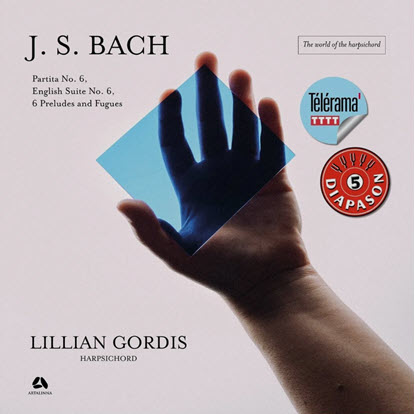
J.S. Bach: Partita No. 6, English Suite No. 6, Six Preludes and Fugues. Lillian Gordis, harpsichord. Artalinna ATL-A045
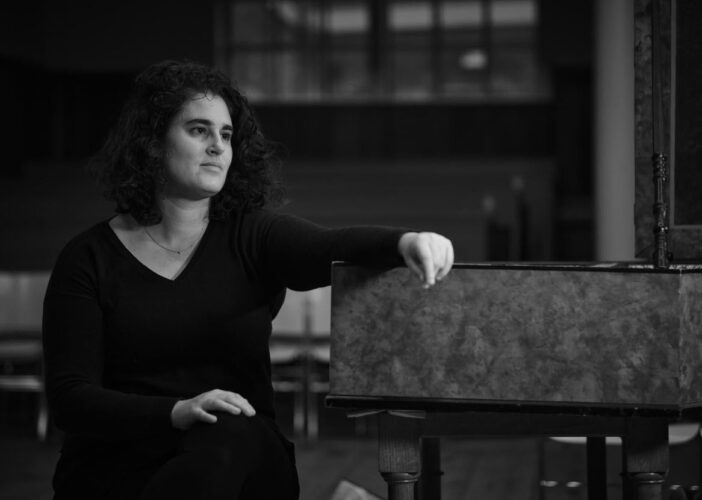
I’ve always enjoyed the eccentricity and confrontational energy heard in Lillian Gordis’ angular renditions of Scarlatti and her punctilious interpretations of Bach. In a previous album (titled simply Bach, from 2022), she played a wonderful harpsichord by Philippe Humeau, constructed in 1999. Under Gordis’ fingers, the instrument shows off its suitability for both strict counterpoint and fiery passage work and, most importantly, the zones where the two converge. In Gordis’ latest album (titled J.S. Bach, from 2026), she again plays the Humeau and, again, we’re graced with the splendid acoustic at the Doopsgezinde Kerk in Haarlem, the Netherlands.
In Gordis’ liner notes, she offers a narrative of maturation, replete with descriptions of her increasing travel, the unique challenges of concert touring, and the commencement of a teaching career. (Read EMA’s insightful 2023 conversation with Gordis as she was preparing to make this recording.)
Indeed, longer arcs are heard throughout this album: its longest track, the Prelude from the Sixth English Suite, opens the entire listening experience, showcasing a narrative whereby seemingly improvised material gradually stabilizes in rhythmic stricture and velocity.
The subsequent movements toy with trance and dissolution: while the Allemande and Courante are matter-of-fact, the Sarabande and Double hint at a conflicting duality between the grounding of the harmonic structure and the faux-improvised repetition of the same; the two Gavottes totter between regal and rustic, where the latter uses a tonic drone akin to a musette to create an aura of sonic continuity; and, lastly, the chromatic ornamentation in the Gigue destabilizes the suaveness of the passage work. I found myself grinning like an idiot as the piece went on, as the narrative proved not to be one of apotheosis, but disintegration and chaos.
Where does one go from there? To preludes and fugues from Book 2 of the Well-Tempered Clavier, naturally. The Prelude in F Major (from BWV 880) contains a refreshing sense of forward motion — (I find many harpsichord renditions constipated) — reflected in the Fugue, where the rhythmic regularity evades pedestrian dialectics. Because we all love and support tertiary relations, we’re treated to a meditative Prelude in A-flat (BWV 862) and a Fugue where a gorgeous chromatic descending figure is presented so smoothly, you might miss that it’s there. I swear, it’s as if the harpsichord were a musical instrument.
I found myself grinning like an idiot as the piece went on, as the narrative proved not to be one of apotheosis, but disintegration and chaos.
Minor thirds to major thirds now. The Prelude and Fugue in C minor (BWV 871) introduces a taste of swag and freedom, sustained in the Prelude in E Major (BWV 878), before a rather serious rendition of a Fugue evoking the stile antico, replete with a choice of temperament which makes the C-sharp and G-sharp Major chords sound spicy and expensive. This is perhaps a good preparation for the Fugue in G-sharp minor (BWV 887), where the sonic clarity of the upper manual highlights the outré nature of the tonality-cum–temperament. The Prelude in B Major (BWV 892) uses registration and manual changes to evoke a ripieno section in a concerto. At the same time, the Fugue’s patient gravitas hints at something heavier or more liturgical.
The final gear shift arrives with the Sixth Partita in E minor, where the Toccata (which itself contains a lengthy fugue) leaves no rock unturned in terms of expressive potential, played with a freedom evoking genuine extemporization. Despite the Italian titles, it is in the Allemanda and Corrente where we ironically hear Bach at his most French, using dotted rhythms in the former and dyssynchrony between the two hands to dispel any notion that this is genuine dance music.
At the same time, Gordis’ regulated interpretation uses articulation rather than smoke and mirrors of agogic delays to showcase these unique facets. Gordis cuts everything loose in the Sarabande, where requisite indulgence is provided for the appearance of an ornament on nearly every note. The Tempo di Gavotta appears as a gigue in disguise, making the rhythmic peculiarity of the actual Gigue all the more puzzling. Indeed, Gordis shows that one of the best things about Bach is that one never quite has one’s expectations met, as form and function diverge in the service of a zwischen sonic experience.
My advice: listen to the album in one go and let your ears guide you as you listen. You won’t regret it.
Parker Ramsay is a harpist and keyboardist based in New York, where he is pursuing a doctorate at Columbia University. He specializes in early and contemporary repertoires. For EMA, most recently, he wrote about Double Meanings for Epiphany, Candlemas.