by Aaron Keebaugh
Published September 28, 2025
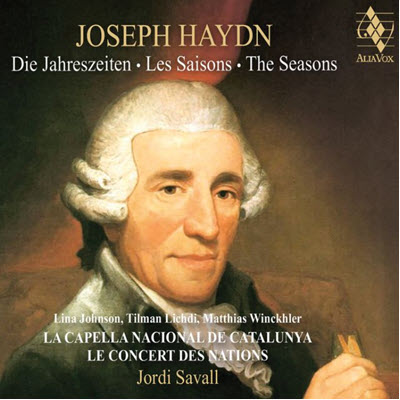
Haydn, The Seasons. Lina Johnson, soprano; Tilman Lichdi, tenor; Matthias Winckhler, baritone. La Capella Nacional de Catalunya and Les Concert des Nations, conducted by Jordi Savall. Alia Vox AVSA9964
Franz Joseph Haydn, though he also sits comfortably in the pantheon, stands apart from these towering figures. Born to an Austrian wheelwright, he came from the lower classes and brought to his eventual success a feel for the earthy qualities that pervaded rural life. Sure, many of his works became the very stuff of aristocratic pleasures. Yet his later oratorios bear a rustic vitality.
With The Seasons, premiered late-in-life in 1801, Haydn shed courtly etiquette in favor of raw expression about the joys and sorrows of life and kaleidoscopic colors of the natural world that surrounded them. Performances and recording of the oratorio, with its echoes of Handel, typically treat these proto-Romantic qualities with operatic sweep, to varying success. But Jordi Savall and Les Concert de Nations take it to tasteful extremes by revealing the pent-up energy and resulting fervor in this welcome new recording. What emerges is no mere nod to cottage-core sentiment but a potent slice of life: burly, occasionally bawdy, and chock-full of good cheer.
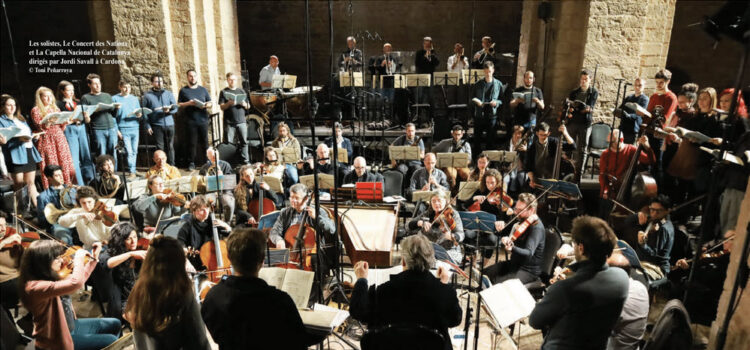
That feat is all the more remarkable given The Seasons’ compositional history. Librettist Gottfried van Swieten, who had scored a previous success with The Creation, transformed much of James Thomson’s original poem into prose. While his text can read as bland and matter of fact, Haydn’s music allows for the lines to flower beautifully. Savall and his superb forces then treat it to Technicolor flourish by leaning into the dramatic extremes. Tutti accents in the overture to Spring hit like hammer strikes. Humor abounds as the winds and strings imitate the sounds of croaking frogs, the rush of wind, and an oncoming thunderstorm. The conductor and ensemble also paint vibrant scenes associated with each season. The overture to Summer evokes the heavy humidity of a sunrise on a hot day. The opening to Winter conveys antipodal coldness through spare passages that suggest the fading of joy into despair.
But the vocal soloist and chorus engender zest and tenderness along the way. As Hanne, soprano Lina Johnson sings with warmth and radiance. Her high notes ring like a crystal goblet; the lower register carries palpable weight. That makes “Willkommen jetzt, o dunkler Hain” come off with soulful intimacy. Tilman Lichdi brings clarion assurance to the role of Lukas. His bell-toned tenor rings proudly in the Cavatina “Dem Druck’ erlieget die Natur” and teases the sunlit richness of “In grauen Schleier.” Lichdi and Johnson combine forces for a dainty and flirtatious “Ihr Schönen aus der Stadt.”
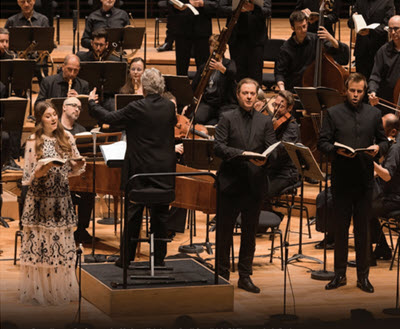
As Simon, baritone Matthias Winckhler provides a sturdy foundation on which the upper lines dance. But he renders the husbandman’s song with affable presence, relaying the joys of hard work. “Seht auf die breiten Wiesel hin” sounds as confident as any hunter on the prowl, while “Erblicke heir, betörter Mensch” from Winter channels the challenges and sorrows of old age. Work may be its own reward, the music suggests, but it takes its toll.
La Capella Nacional de Catalunya sings with diction of spring-water clarity and blend that feels just as fresh. “Komm, holder Lenz” reveals Spring in all its blooming glory. “Bittgesang” resonates with the intimacy of a personal prayer. The hunting chorus “Hört das laute Getön,” adorned by offstage horn calls, bounds with almost Mahlerian verve.
Joy, it seems, abounds all around. “Juhhe, juhhe” concludes Autumn in jovial drunken splendor. But as Winter’s chill sets in, visions of warmer days — and better times — remain. “Dann bricht der große Morgan an” concludes it all with a firm conviction: after a year of hard work, hard partying, and hard times, the sun will shine anew.
Aaron Keebaugh has written for The Classical Review, Boston Musical Intelligencer, Corymbus, The Musical Times, and The Arts Fuse, for which he serves as regular Boston critic. For EMA, he recently reviewed Sky of My Heart with New York Polyphony and Lestrange Viols.