by Andrew J. Sammut
Published June 23, 2026
Pièces en solitude. Caroline Nicolas, viola da gamba. Avie AV2861
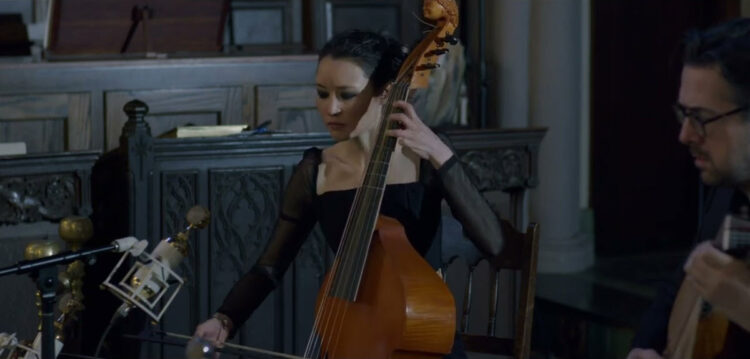
Born in Winnipeg, living in New York, viola da gamba player Caroline Nicolas has already built an expansive resume, as a performer with acclaimed European and North American period-instrument groups, as a teacher, and, not least, as founder and director of Ars Poetica — an ensemble that performed on the 2025 EMA Emerging Artists Showcase. Yet she mentioned to me, via email, that “self-imposed limits” fascinate her so much that, when she was ready to release her debut solo CD, she and theorbo player Kevin Payne “spent one really long day in the studio seeing what would happen.”
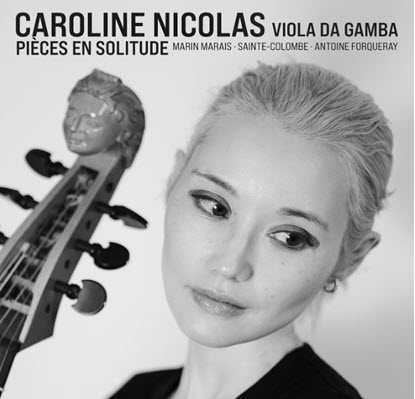
The resulting disc features works from France in the 17th and early 18th centuries, the golden age of the gamba, by some of the instrument’s seminal composers. The names are likely familiar to fans of this repertoire, and the album’s title might imply calm, but the program shows several sides of the performers and composers.
Marin Marais may be the best-known name from this genre. He studied with two giants: Sainte-Colombe, the enigmatic gambist who brought the instrument to new heights and introduced its seventh string, and opera composer Lully, whose influence dominated French music for decades even after his death. Marais spent most of his time as a musician in Louis XIV’s court, shaping the development of this instrumental idiom through his students and the five books of Pièces de viole he composed throughout his life. These selections comprise most of this CD.
Six movements from the Suite No. 1 in D minor of the Pièces de viole avec la basse-continue by Antoine Forqueray, each named after figures of the time, form another significant part of the disc. 16 years younger than Marais, Forqueray’s more aggressive music and volatile personality earned him the nickname “the devil” in contrast to “the angel” Marais. While the elder composer rejected Italian styles, Forqueray welcomed them even as the viol’s popularity declined. Single movements by Sainte-Colombe and the influential teacher/composer de Machy round out the program.
Even with Forqueray at his most extroverted, this repertoire rests on how well an interpreter balances its restrained air and the French style’s subtle rhythms and ornaments with expressiveness and musical interest. Nicolas plays with passion and originality without overwhelming the music. Not to take away from the emotional arc of the track sequence, but the “Plainte” movement from Suite No. 4 in D minor of Marais’s Livre 3 sums up the disc’s strengths. Sensitive melodic shaping and a range of string colors bring out this lament’s vulnerability, tinge of bitterness, and closing notes of hope. It’s the type of stylized, complex musical communication that makes this corner of classical music at once so distinct and so tricky to pull off.
The dance element integral to French Baroque music is there but channeled toward affect and character. The brisk clip and sharp accents for Forqueray’s “La Borde,” for example, portray a competitive fellow composer. “La Portugaise” alternates tense, rhythms in acrid tones and silkier, unbuttoned cascades, creating a vivid personality and interesting textural play.
Nicolas’ refined touch pairs well with Payne on theorbo, as the continuo (and also her husband). Her liner notes explain that this option enables a “conversational interplay” that larger accompaniments can obscure. It’s hard to argue with the clarity this choice brings or the easy flow between the two musicians. Forqueray’s “La Cottin” features bright cross voicings between the two instruments. The eponymous movement from Forqueray’s suite comes off like a duet, sometimes hinting at heated conversations between the composer and his father.
Without the steady drone of a second gamba or other sustaining bass instrument in the continuo, Nicolas doesn’t need to compete in terms of dynamics or cut through a wall of arpeggios. The additional acoustic space lets her explore finer gradations of sound and mood. The Allemande from Marais’s Livre 3, Suite No. 7 in G, starts with extreme delicacy, detached in both rhythm and feeling, with its succeeding “Double” in slightly broader strokes, an experiment in degrees (rather than predictable extremes). Gentle rhythmic accents add a sardonic edge to the last two movements of Marais’s Suite No. 1 in A minor from his Livre 3.
There are several stylish choices on this disc, and some catch the ears even more alongside other interpretations. Sainte-Colombe’s Chaconne in D minor (from Pièces pour basse de viole seule, Tournus manuscript 49) assumes a tense atmosphere, partly due to its unrelenting momentum but also Nicolas’ tossing out lines like they’re one breath. Likewise, she finds a few dimensions in the “Badinage” from Marais’s Livre 4, Suite d’un Goût Étranger. The movement’s name refers to sophisticated, allegedly good-natured teasing. Nicolas’ moderate, mostly steady tempo and cool delivery seem to be taking the joke apart after the fact. The main four-note motif is delivered in halting steps and calculated, even rhythms. Instead of just sprinting ahead, this jest rattles around in the subject’s head.
This is a deeply individual debut recording. Combined with a closely captured studio sound, it’s also an up-close-and-personal experience, yet not always a comforting one. Like the real thing, the “solitude” of the album’s title reveals much more than peace and reflection.
Andrew J. Sammut covers music for Early Music America, the Syncopated Times, Vintage Jazz Mart, and his blog, the Pop of Yestercentury. He has also written for All About Jazz, Boston Classical Review, and Boston Musical Intelligencer. For EMA, he recently reviewed Cantata Collective’s St Matthew Passion.