
by Ken Pierce
Published June 15, 2026
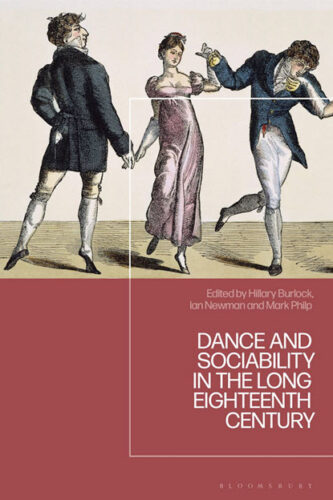
Dance and Sociability in the Long Eighteenth Century edited by Hillary Burlock, Ian Newman, and Mark Philp. Bloomsbury Academic, 2026. 280 pages.
Why do people dance?
“Because it’s fun!” might indeed be the best answer. But as Dance and Sociability in the Long Eighteenth Century makes clear, there’s a lot more to it than that. In 18th- and 19th-century Europe and into the colonial Americas, dancing in a social setting could be a way to establish or maintain connections; to display strength, stamina, and technical skill; to meet and impress — or assess — potential spouses; or to assert membership in a certain echelon of society. A dance, or an evening of dancing as at a public ball, was a means to display not only physical grace, but also social grace — the ability to interact appropriately with members of one’s own class.
At another level, people danced in order to learn to dance. Regular lessons with a respected dancing master provided basic skills: not only how to perform specific dances or dance steps, but also how to stand, how to walk, how to bow, and generally how to hold oneself while under the gaze of others. Dancing masters (male or female) offered training in the latest dances while also teaching dances that had long been staples of the ballroom repertoire. They might also sponsor public balls at which their students could display their skills and, implicitly, the value of the dancing master’s tutelage.
Dance and Sociability offers detailed, sometimes fascinating descriptions of the social context for European dance, primarily of the upper classes, in the late 18th and early 19th centuries. The editors explain that the publication was developed from work presented at online and in-person conferences in 2021 and 2022; the 2022 conference also included practical sessions and movement workshops.
As is typical of conference proceedings, this book gathers articles on specific, focused topics, including dance lessons in Norway, a dancing master in Philadelphia, music and dance in Edinburgh, ballrooms in Georgian England, the transmission of dances to the West Indies, and so on. The editors offer an insightful overview in their introduction, and one of them, Hillary Burlock, contributes an astute, thought-provoking article on the question, relevant to all the chapters, of how to define “grace.” But inevitably it is up to the reader to assess and synthesize the material presented in these articles, to accept that there are gaps, and to notice the occasional contradiction.
During the period in question, a ball or dancing assembly served not only the dance-related purposes listed above. Even for those who were not dancing, it would be an occasion to socialize, or to discuss business, and to display wit, charm, and conversational skill. It would also be an important opportunity to demonstrate proper taste in clothing, and familiarity with — and the means to afford — the latest fashions. For the hosts, it was a way to impress others with refreshments served in a lavishly decorated space.
In her chapter “Dance at home in Georgian England,” Katrina Faulds cites an 1818 newspaper’s description of a fancy dress ball at St. James’s Square:
Highlighting the house’s “architectural embellishments” and describing the ballrooom ceiling in architectural terms, the newspaper subsequently noted the sensory sumptuousness of the interior decorations — perfumed flowers and plants, glistening chandeliers and the “luxury and magnificence” of the supper rooms — along with the “dazzling richness” of the costumes. Dancing was barely mentioned, beyond the fact that quadrilles and waltzes were performed.
Several of the articles in Dance and Sociability describe ballrooms or other spaces in which dancing took place — spaces that accommodated dancers, musicians, and onlookers, with ancillary spaces for eating, drinking, playing cards, or resting. A ballroom might be a permanent, purpose-built space. It might be a space designed for some other purpose but adapted for dancing, or might even be a temporary structure, set up for a specific occasion. Dancing outdoors, in the street or elsewhere, was also a possibility:
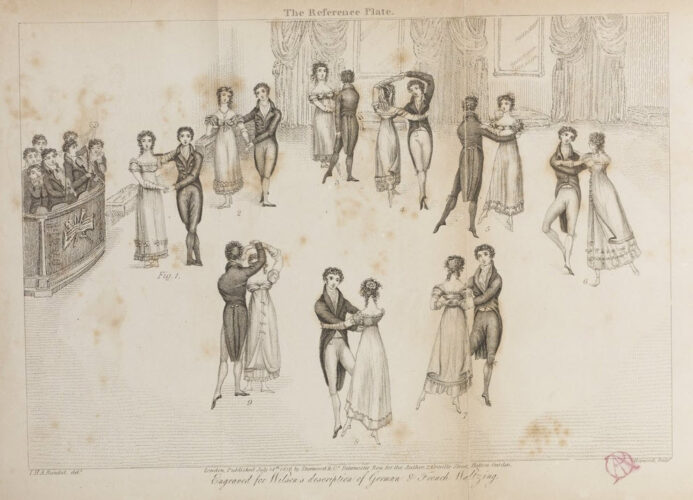
Waltzes could also be danced in open-air venues such as the famous Prater or the Augarten: in these locations, picnic balls — a combination of picnic, dinner and ball — seem to have been the most popular type of dance event during the Congress [of Vienna, 1814–15].
This passage is from Hanna Walsdorf’s perceptive essay “‘German’ vs. ‘Viennese’: Notes on the social and conceptual history of waltzing in the German-speaking world.” Hers is one of the chapters that looks at specific dances or dance forms that had once been popular.
Across these chapters, definitions sometimes become blurry. Was the Minuet de la Cour — many dance historians spell it “Menuet” — a fixed, notated couple dance, or did it somehow devolve into a more generic couple dance or possibly a group dance? Similar questions pertain to the well-known loure “Aimable Vainqueur” from 1701: Did it remain as the original duet, possibly with ornamentation as in Kinski’s 1751 manuscript, or did it morph into something more pedestrian? The book’s index is of little help: It lists both dances under “dance forms,” although the Minuet de la Cour is in a sublisting under “minuet.”
Dance and Sociability, despite some inconsistencies or lacunae, is a valuable, thought-provoking collection of recent scholarly work that will be of interest to anyone who seeks to understand the important role of dance in shaping European society.
Ken Pierce is a choreographer, reconstructor, performer, and teacher based in Cambridge, Mass. He teaches historical dance at the Longy School of Music of Bard College and teaches ballet and historical dance elsewhere in the Boston area.