by Anne E. Johnson
Published August 19, 2024
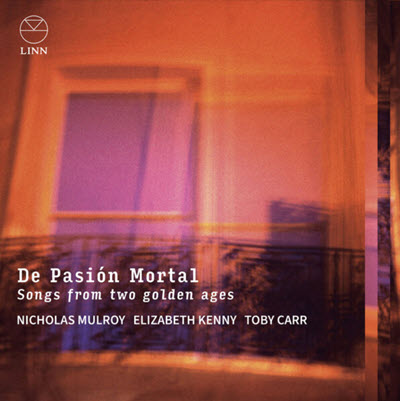
De Pasión Mortal: Songs from Two Golden Ages. Nicholas Mulroy, tenor; Elizabeth Kenny, archlute, guitar, theorbo; Toby Carr, guitars, theorbo. Linn Records CKD 746.
“We all walk the same ground” could have been the tag line for British tenor Nicholas Mulroy’s latest project on Linn Records, De Pasión Mortal: Songs from Two Golden Ages. The recording, which also features theorbo, archlute, and guitar played by Elizabeth Kenny and Toby Carr, seeks to draw a parallel between early European Baroque and 20th-century Latin American songs. What results is a beautiful experiment, despite the tenuousness of the underlying thesis.
Mulroy claims that the songwriters of these two planes are connected by the fact they “have urgent truths to tell us.” That descriptor, of course, could apply to any significant songwriter from any time or place. But in his program notes, Mulroy also points out an intriguing technical connection: Monteverdi and Purcell both employ a fundamental compositional device that also shows up over 350 years later in the songs of the Cuban Silvio Rodríguez (born in 1946) and the Chilean Víctor Jara (1932-1973).
It’s not much to go on (and other traditions do it, too, not to mention the post-punk/goth band The Cure), but it’s a defensible enough excuse to pair these two vocal traditions.
The majority of the early works on this album are by Henry Purcell, represented by seven tracks, mostly songs. Claudio Monteverdi’s “Tempro la cetra,” a solo-voice madrigal from his Book 7, is the only other piece from before the mid-1900s.
Purcell’s “O fair Cedario” drips with longing, whereas Mulroy applies his unusually bassy tenor with a more intense energy in “The sparrow and the gentle dove.” As an instrumental aside, Carr and Kenny are joined by five seasoned experts on bowed Baroque instruments (including violinists Margaret Faultless and Rachel Stroud), calling themselves Music for a While, in a moving performance of the Fantasia in G major. Cellist Andrew Skidmore gracefully maps out the ground bass for the song “By beauteous softness.”
Kenny gives a Latin twist on guitar to a Prelude and Gigue from The Fairy Queen. Thematically, however, there is little to connect the early songs with the later. Then again, Mulroy’s soul-wracked reading of Purcell’s “In the black dismal dungeon of dispair” could be seen as a nod to the social injustice faced by many Latin American artists in the 20th century. Víctor Jara, represented here by his song “Te ricuerdo Amanda,” was imprisoned, tortured, and shot to death by a junta government for his political activism.
Four of the Latin songs are by Silvio Rodríguez. “Óleo de mujer con sombrero” lets Carr and Mulroy blend a freely phrased vocal line with a subtle but free guitar part. Mulroy shapes Rodríguez’s “Ójala” into elegant phrases; he sings this style with as much ease as he does Purcell.
There are four other Latin American composers on the list: Tomás Méndez (1927-95), Ariel Ramírez (1921-2010), Ñico Rojas (1921-2008), and Rafael Hernández Marín (1892-1965).
Méndez wrote “Cucurrucucu paloma,” which became popular in the 1960s in part thanks to the singing of Harry Belafonte. The opening of Ramírez’s “Alfonsina y el mar” is sung a cappella, as if Mulroy were just passing the time with a familiar tune; then, when the accompaniment begins, sweeping melodic motions and surprising harmonic twists take over.
This is a pleasing album. As all of us who love early music try to expand our minds and ears to appreciate a wider, more diverse repertoire, we should be grateful whenever our plateful of Baroque comes with a heaping helping of a different flavor, like the delicacies offered here.
Anne E. Johnson is a freelance writer based in New York. Her arts journalism has appeared in the New York Times, Classical Voice North America, Chicago On the Aisle, and PS Audio’s Copper Magazine. She teaches music theory and ear training at the Irish Arts Center in Manhattan. For EMA, she recently reviewed period-instrument chamber music by Robert Schumann.