by Ken Meltzer
Published July 28, 2025
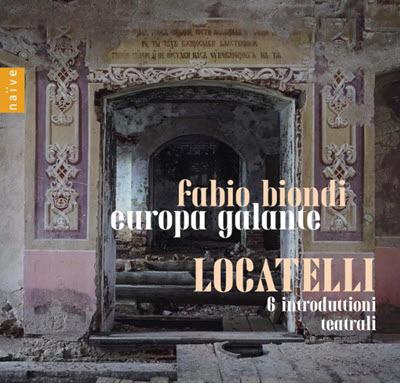
Locatelli: 6 Introduttioni teatrali, Concerto per violino e archi. Europa Galante led by violinist Fabio Biondi. Naïve Classiques B0F9LP77D2
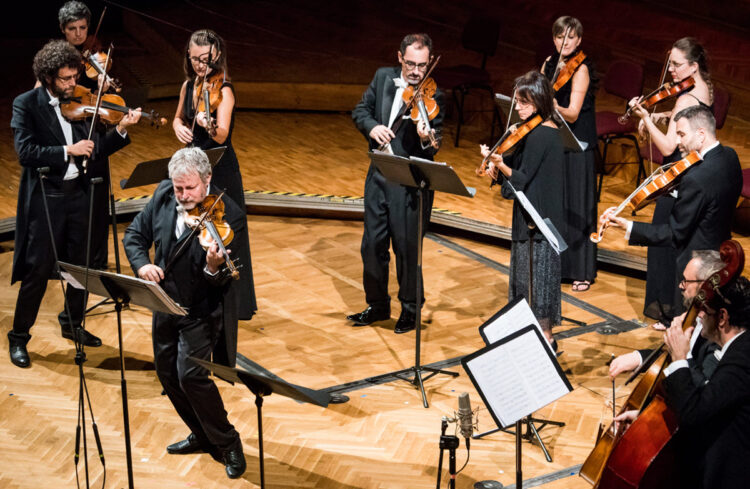
An outstanding new Naïve Classiques release features violinist Fabio Biondi and his period-instrument ensemble Europa Galante performing Pietro Antonio Locatelli’s six Introduttioni teatrali and Concerto for Violin and Strings in A Major. The concerto (DunL 1.5) is neither among Locatelli’s published works nor included in any of his personal catalogues. But two manuscripts, located respectively in the Sächsische Landesbibliothek in Dresden, and the Statens Musikbibliotek in Stockholm (bearing the autograph notes of Johan Helmich Roman), provide the evidence of Locatelli’s authorship.
The composer was one of the foremost violinists of his era, and the concerto showcases the instrument’s capacity both for brilliant passagework and songful expression, adopting the traditional three-movement structure, with the opening Vivace succeeded by a songful Largo. The final movement’s principal Allegro alternates with a pair of Andante episodes. Toward the close, a fully transcribed capriccio and cadenza offer the concerto’s most brilliant solo opportunities. Fabio Biondi performs the solo with virtuosic flair and precision, and a lovely, focused tone. All told, most enjoyable.
Published collectively as part of Locatelli’s Opus 4 in 1735, the Introduttioni (Introduzioni) teatrali may have been intended to precede stage performances at the Amsterdam Municipal Theatre, located near the well-traveled composer’s adopted home. Another possibility, as Fulvia Morabito suggests in liner notes for the Naïve recording: “Locatelli might have conceived the Introduzioni regardless of any contingency and thus as stand-alone instrumental pieces.”
Whatever their intended function, Locatelli’s Introduzioni embody a gratifying synthesis of established Baroque forms, adopting the concerto grosso’s incorporation of a concertino (here, two violins, viola, and cello) and a (string orchestra) ripieno. But rather than juxtapose the two entities, Locatelli has the concertino and ripieno perform, for the better part, in unison. That approach modifies somewhat in the finales, where the concertino is occasionally highlighted in solo fashion. The three-movement (fast-slow-fast) structure of the Introduzioni mirrors the Italian opera overture (sinfonia) then in vogue. Locatelli employs this hybrid concerto grosso/sinfonia structure as the foundation for vivacious, charming music, filled with delightful contrasts of dynamics and texture. It’s easy to envision these delightful works as apt preludes to an evening at the theater. Europa Galante and Biondi offer sparkling, taut, and marvelously transparent renditions.
Ken Meltzer has served as program annotator for the Pittsburgh and Atlanta Symphony Orchestras. He currently authors program notes for several U.S. orchestras, and reviews recording for various publications. For EMA, he recently reviewed marvelous Couperin and Bach from Les Délices.