by Anne E. Johnson
Published May 27, 2026
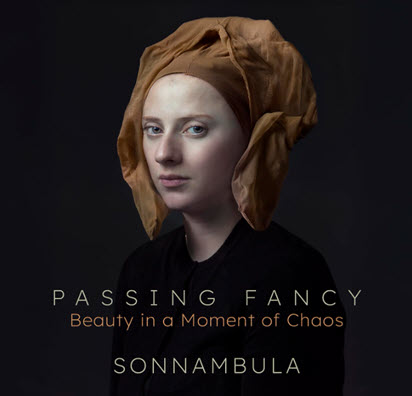
Passing Fancy: Beauty in a Moment of Chaos. Sonnambula, directed by Elizabeth Weinfield, with tenor and harpsichordist James Kennerley. Avie Records AV2746. Total time: 53:35
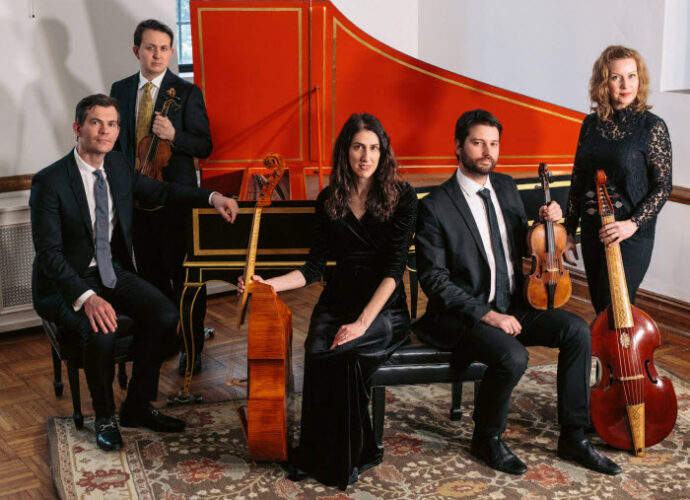
Great artists express their identities through their art, yet many artists are forced to live in a society that does not accept their true identity. Passing Fancy: Beauty in a Moment of Chaos, from the New York-based viol ensemble Sonnambula, explores works by a range of such societal outcasts from the 16th and 17th centuries.
Two of the composers are women who were attempting to succeed in a profession understood to be men’s domain. The album opens with Élisabeth Jacquet de la Guerre’s (1665–1729) Overture to Céphale et Procris, a 1694 opera composed despite the still overwhelming (and posthumous) power held by Jean-Baptiste Lully over that genre in France. Under the direction of Elizabeth Weinfield, the ensemble plays with ruddy energy, eschewing the overly careful approach that can push a French overture into unfortunate daintiness.
There are also two sinfonias by Leonora Duarte (1610–1678), a Portuguese Jew forced to convert to Christianity. The sinfonias are presented with new arrangements by harpsichordist James Kennerley featuring a colla parte role for his instrument, a technique intended to follow the rhythm and phrasing of the main melody line. Duarte’s musical ideas spill into each other harmonically, a fact that Sonnambula takes full advantage of in their phrasing.
An earlier example of involuntary conversion was Jewish-born Spanish composer and singer Enric de Paris, also known as Enrrique (fl. 1460s), whose “Mi querer tanto vos quiere” is performed by Kennerley, a tenor as well as harpsichordist. It’s one of the many early Renaissance texts about a love worth dying for, and Enrrique sets it with long notes in an angular melodic shape, more like prayer than romance.
Salamone Rossi (c.1570–1630), a madrigalist and instrumental composer at the court of Mantua, stands out for being allowed to keep his Jewish faith. He is represented here by a sonata from 1622 and a setting of Psalm 80 from 1607. The latter is sung in Hebrew by Kennerley, his vocal line somber and contemplative against the dense viol accompaniment, while at times trading instrumental-like runs with the players.
Some composers have been persecuted for choosing to convert. Englishman Richard Dering (c.1580–1630) became a Catholic, which forced him into exile. His Fantasias No. 5 and 6 have a wistfulness in their meandering sequences and creeping dissonances. William Byrd (c.1540–1623), who managed to ingratiate himself with both Catholic and Protestant monarchs, makes a brief appearance with a couple of short keyboard works, which Kennerley plays elegantly.
The only mystifying presence here is Alfonso Ferrabosco I (1543–1588), an Italian madrigalist who worked in England for most of his career. Weinfield does not explain, but maybe she included him because some scholars believe he was a spy for Elizabeth I and was forced to leave England after trumped-up charges of violent crimes. Whatever the reason, it’s a pleasure to hear Ferrabosco’s five-viol instrumentation of an In nomine setting.
Sonnambula’s rich and heartfelt playing, recorded for disc at New Jersey’s Drew Univ. Concert Hall, is enhanced by the vivid sound production and mastering of Marlan Barry.
Anne E. Johnson is EMA Books Editor and frequent contributor to Classical Voice North America. She teaches music theory, ear training, and composition geared toward Irish trad musicians at the Irish Arts Center in New York and on her website, IrishMusicTeacher.com. For EMA, she recently reviewed the enchanting sounds of Baroque Music Montana.