by Ken Meltzer
Published July 17, 2026
Domenico Scarlatti Sonatas: A 1791 Publication edited by Muzio Clementi for the Piano-Forte. Charles Metz, piano-forte. Navona Records NV6558
In 1791, pianist, composer, and keyboard manufacturer Muzio Clementi published a series of 12 sonatas by Domenico Scarlatti (although it was later discovered that one of the sonatas was by an anonymous composer, another by Antonio Soler). Clementi edited the sonatas, originally composed for harpsichord, for performance by either the harpsichord or its successor, the nascent piano. As Charles Metz, who performs the Clementi/Scarlatti works in a Navona release, observes: for this 1791 publication, “including the harpsichord was more for sales of the edition to those who still owned a harpsichord and had not made the transition to piano-fortes.”
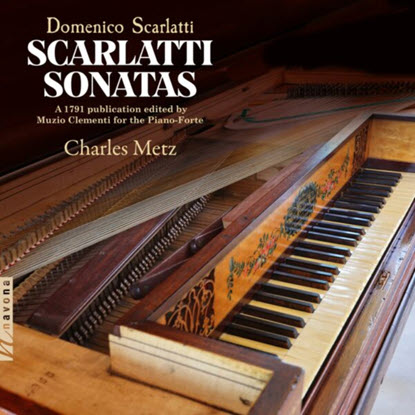
Clementi’s versions of the Scarlatti sonatas allowed for exploration of the piano-forte’s increased capacity for dynamic range, expressive markings, and legato. In this recording, Metz performs the Clementi editions of the Scarlatti Sonatas on an instrument of the period. And therein lies a remarkable tale in its own right.
The instrument in question, a square piano bearing serial number 4863, was manufactured in 1806 by Clementi’s own company in Cheapside, London. Two centuries later, the instrument was for sale in an antique store in Santa Barbara, California. The square piano’s mysterious odyssey from London to Southern California might be the stuff of a compelling book or movie. As Metz describes, the Clementi piano’s “voice hadn’t been heard in decades. Its original ivory keys were worn down after two centuries of ardent keyboardists pouring their musical souls into the instrument.”
Once discovered in Santa Barbara, Metz placed the Clementi square piano in the care of Dale Munschy of South Weymouth, Mass., who restored the instrument to its current playable state. (For EMA, Metz wrote about his collection of rarities: “Home is Where the Keyboards Are.”)
As residents of Los Angeles, my wife and I frequent Santa Barbara and, on occasion, its charming consignment shops and antique stores. Were we ever in the shop that housed this precious instrument? Did we ever pass it by, oblivious to the sounds held within this historic piano? On to matters of greater concern.
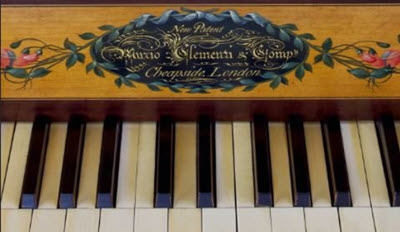
The Clementi square piano, as restored by Munschy, is a lovely instrument. It possesses a clear, bell-like tone throughout the registers. Although of modest size, the Clementi piano can summon impressive authority. On this recording, Metz, a student of keyboard masters Igor Kipnis and Trevor Pinnock, performs with a keen ear for the instrument’s range of colors and dynamics. He plays with unfailing clarity and elegant phrasing. And alongside his exploration of the Clementi piano’s sonic potential, Metz phrases with a restrained, highly artistic flexibility of phrasing. Clementi’s 1791 edition of Scarlatti’s Sonatas, which embodies the transition from the Baroque to the Classical eras, anticipating the early dawn of the Romantic period. To my ears, Metz’s refined and poetic renditions comport with that aesthetic.
The recording, made at the famed Skywalker Studios in California, boasts excellent sound, conveying the beauty, range, and subtleties of the Clementi piano, without any sense of artificial enhancement. Metz’s program notes are a fine complement to his engaging performances.
Ken Meltzer was program annotator for the Pittsburgh and Atlanta Symphony Orchestras. He currently authors program notes for several U.S. orchestras, and reviews recording for various publications. For EMA, he recently reviewed Hannah De Priest singing Arcadian Dreams in Cleveland.