by Barbara Dietlinger
Published September 13, 2026
Music in Fifteenth-Century Bohemia: Between Reform and Identity Building. Edited by Hana Vlhová-Wörner and Jan Ciglbauer. University of Rochester Press, 2025. 292 pages.
Bohemia in the 15th century has been described in two ways that cannot both be true: In the Czech telling, it is where a distinctively Czech musical culture was born, sung into being by the followers of the reformer Jan Hus in their own language; In historical surveys of Western art music, Bohemia is barely present at all, a periphery sealed off by war and heresy. The first view was built on a narrow selection of sources and some badly copied transcriptions, while the second came about from only ever looking for masterpieces.
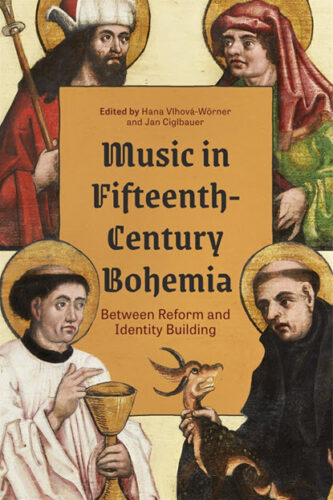
The six essays in Music in Fifteenth-Century Bohemia go back to the sources. A seventh was never finished: Lenka Hlávková, who wrote the chapter on polyphony, had also drafted an essay on rhythmic chant when she was killed on Dec. 21, 2023, in the mass shooting at the Faculty of Arts of Charles University, where she directed the Institute of Musicology. Hana Vlhová-Wörner summarizes the draft of Hlávková’s unfinished essay in her introduction, and the book is dedicated to her.
The volume grew out of a Czech Science Foundation project with the fitting title “Old Myths, New Facts,” based at Charles University and the Masaryk Institute. It collects five studies of individual repertoires, covering sequences, the chants for Jan Hus, singing in Czech, the sacred songs called cantiones, and polyphony. A closing chapter focuses on 19th-century reception. (Readers wanting a survey rather than a specialist’s companion should turn instead to A History of Music in the Czech Lands, which Vlhová-Wörner co-edited.)
A sequence is a Latin song sung at Mass just before the Gospel reading. The handbooks declared this genre finished, but in Bohemia quite a lot happened afterward. The verdict came from Bruno Stäblein, who in 1965 wrote the entry on “sequence” for the first edition of Die Musik in Geschichte und Gegenwart, the standard German music encyclopedia. Stäblein wrote off everything after about 1200 as “the reverberation after the zenith,” and treated the 15th- and 16th-century revival as a last phase of amateur tinkering. Vlhová-Wörner opens by pointing out that most Bohemian sequence sources come from precisely that discredited period. Working chiefly from Prague sources, she shows a genre that kept absorbing new functions as sequences were drawn into private devotion, folded into the cantio repertory, translated into Czech, and newly written for Hussite use.
The most striking finding is a negative one, namely, that the sequences were never displaced, even in the Utraquists church, which came out of the Hussite revolt, where one might have expected the newer cantiones to crowd out the older ones. Sequences were old, and being old was the point. The Utraquists kept them, along with much else from the Roman rite, as evidence that they belonged inside the Western church rather than outside it. The research rests on an open-access database of Bohemian sequences, which the chapter points readers toward.
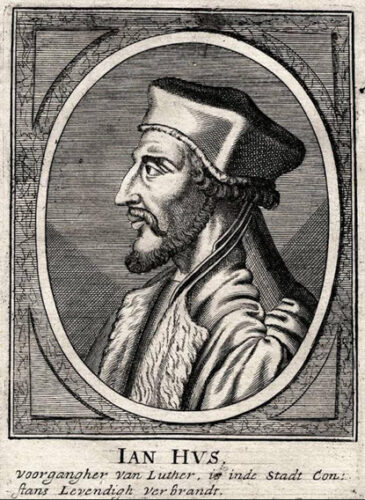
Rhianydd Hallas asks what survived and what was destroyed of the chants written for Jan Hus, who was condemned as a heretic and burned in 1415. Within a year, Hussite Bohemia was celebrating his feast, its music borrowed at first from the martyrs generally and later written for him. Only two extant manuscripts carry substantial numbers of chants for his Office, one of which was copied in the 1520s by Stephan Roth, a correspondent of Luther. In 2009 Vlhová-Wörner and David Holeton, the historian of Utraquist liturgy, published the Hus Office from old photographs, working from the only part of the Roth manuscript anyone had images of. The manuscript itself was misattributed and its whereabouts unknown.
Then, in 2018, Lucie Doležalová traced it to the council school library in Zwickau. Hallas can now read the chants in context. Why a German Lutheran wanted a Czech saint’s office she can only guess. The chants themselves, she writes, are “firmly and intrinsically rooted in the liturgy, music, and traditions of the Roman Church.”
“Faith comes from hearing.” Eliška Baťová takes her epigraph from Václav Koranda the Younger’s 1493 Czech rendering of that line from Romans, and that sentence is the whole case for singing in Czech, since a congregation can only be reached in a language it understands. The chants and songs she gathers from the later 15th century share no genre and no single slot in the service. What unites them is that all were meant to reach ordinary worshippers, and that concern determined which texts were translated and which were newly written. Czech singing never replaced the Latin liturgy but grew alongside it, permitted parish by parish on the argument that local custom allowed it, until printing after 1500 made local custom irrelevant.
Not only is Jan Ciglbauer’s chapter the most openly historiographical, but it is also the most useful for seeing why the field looks as it does. He considers who first brought songs into the Mass. Czech and German hymnology worked as rival national schools in the 19th and early 20th centuries, each claiming the innovation for its own reform movement, and after 1945 the Iron Curtain cut Western scholars off from Czech archives. Reading the synodal statutes on both sides of the border, Ciglbauer finds bishops everywhere banning songs, which is itself proof that the singing was going on. The sharpest bans come from Bohemia around 1410, exactly where the songs were most abundant: in 1408 the archbishop of Prague forbade every new Czech song but four. Ciglbauer describes the Bohemian contribution as “a significant regional acceleration of common tendencies,” driven by reform ideas circulating from around 1380, and doubts that a contest of firsts can be settled at all on evidence this fragmentary. It is an unglamorous conclusion that dissolves a century of competitive claim-staking.
The chapter on polyphony surveys the 1450s to the 1530s, focusing on six manuscripts, chief among them the Codex Speciálník. Lenka Hlávková had been working on that codex since her 1998 thesis. Her proposal is that the court of Vladislaus II Jagiellon, long overlooked, was a significant center for Franco-Flemish polyphony in central Europe.
What makes her proposal persuasive is that the evidence is not new. Regensburg’s city accounts record a payment in 1481 to seven singers of the Bohemian king, who were in town alongside the singers of the Burgundian duke, and the musicologist Reinhard Strohm cited the entry in a footnote to The Rise of European Music in 1993. Nothing then suggested a royal chapel in Prague, so the singers were taken to be Matthias Corvinus’, since he too held the Bohemian crown. The Speciálník is now dated to around 1480, when Vladislaus was still in Prague, which makes those seven singers plausibly his. Hlávková concedes that no direct evidence for a royal chapel in Prague has surfaced, while taking it for granted that a monarch of the period must have employed clerics trained to sing polyphony. But a footnote that waited 30 years for a context in which it could be read is not the same as a guess.
Viktor Velek closes the volume with a chapter on the years 1800-1848. Czech scholarship has usually dated the Hussite musical revival to the 1860s, when political conditions eased and the war song “Ktož jsú boží bojovníci” (You who are warriors of God) was at last heard as music rather than read as text. Velek finds it starting decades earlier with the Habsburg government. During the Napoleonic wars Vienna needed Czech recruits, so it eased the censorship on Hussite subjects and backed patriotic songs that called Czechs to arms in the name of their Hussite ancestors, on the theory that a nation with a fighting past would fight again.
It worked better than intended: After 1815, the authorities tried to make the Hussites villains again and failed. Velek’s explanation for why those who knew both text and music went on ignoring the tune is that the philologists cared only about words, and music history was not yet a discipline that could take up the rest. The chapter’s supporting documentation, including a synoptic transcription of three of the anti-Napoleonic songs, is free on the publisher’s website.
The collection is unevenly weighted, with Velek’s 40-odd pages on the 19th century sitting awkwardly beside the five chapters on the long 15th. Moravia and Silesia are thinly served, too, for a volume whose project claims the Czech lands, a gap that is presumably someone’s next book. Neither dents the achievement. Taken together, these essays quietly dismantle the idea that Bohemian music of this period was a national exception, to be studied apart from the rest of Latin Europe, and for the 15th century they do it by going back to the manuscripts. For chant scholars, historians of the long Reformation, and performers building programs from this repertoire, it is the place to start.
Barbara Dietlinger is assistant professor of music history at the University of North Texas. Her research focuses on the interplay of music, visual art, and print culture in memory formation in Saxony, Bohemia, and the Low Countries during the early modern period. She took Lenka Hlávková’s course at the Faculty of Arts of Charles University during an Erasmus semester in 2011 and remained in friendly contact with her.