
by Ken Meltzer
Published August 28, 2026
On period instruments, Shaw’s surreal kaleidoscope of textures, colors, and dynamics emerges with arresting impact
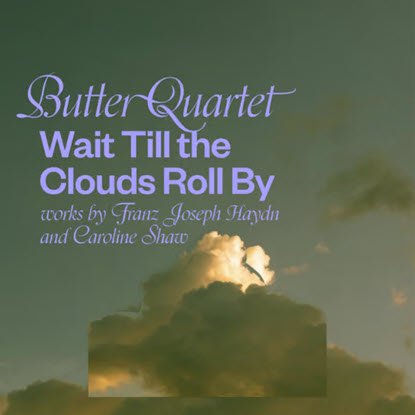
Wait Till the Clouds Roll By, works by Franz Joseph Haydn and Caroline Shaw. Butter Quartet. Brilliant Classics 70033
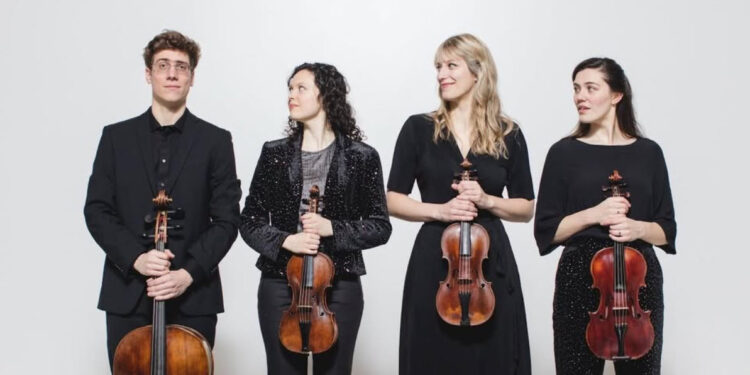
The repertoire on the Butter String Quartet’s newest album, Wait Till the Clouds Roll By, encompasses several aspects of the group’s artistic mission: researching late 18th- and early 19th-century performance practice, with Franz Joseph Haydn central to their repertoire, as well as newly composed works suitable for period instruments. Here it’s two of Haydn’s late-in-life Op. 77 String Quartets and contemporary American composer Caroline Shaw’s Entr’acte, from 2011, inspired by one of the Haydn movements.
As in the Butter’s debut recording, Scintilla (reviewed by EMA in 2024), the four musicians — violinists Anna Jane Lester and Chloe Prendergast, violist Isabel Franenberg, and near-namesake cellist Evan Buttar — play everything with crispness, boundless energy, and heightened sensitivity, a remarkable combination. (In 2018, the Butter Quartet were the first ensemble to received an EMA Workshop Scholarship, awarded to the group so they could attend the Evolution of the String Quartet program at the Banff Centre for Arts and Creativity.)
Their latest recording’s title refers to the association between the Andante melody from Haydn’s Op. 77 No. 2 and the late 19th-century song “Wait Till the Clouds Roll By.” The disc closes the Haydn Quartet in G Major, Op. 77, No. 1.
There is much to savor in the Butter Quartet’s renditions of the two Haydn works. The ensemble’s perfect intonation, easy unanimity of ensemble, and marvelous balancing of voices allow full appreciation of the music on period instruments. Vibrato is used sparingly, for effect. The strings’ textural clarity and lovely timbre bring great pleasure. They also push the boundaries of familiar repertoire. In the Presto movement of the G Major Quartet, for example, the Butters follow the explosive 1854 metronome markings by musicologist Karol Lipiński, moving with a gleeful fleet-footedness that likely only virtuosic, historically informed players on period instruments could achieve convincingly. They make it all sound so right.
It’s clear the musicians listen with the utmost intensity to each other, an especially rewarding element in works that feature the frequent, conversational exchange of motivic fragments. In repeated sections, the quartet often introduces variety in the form of delicate ornamentation and modifications of phrasing, including use of rubato that accentuates Haydn’s episodes of drama and humor.
American composer Caroline Shaw, born in 1982, was inspired to compose Entr’acte after hearing the modern-instrument Brentano String Quartet perform Haydn’s Opus 77, No. 2. Describing her inspiration, Shaw notes in particular the Brentano’s “spare and soulful shift to the D-flat Major trio in the minuet.” Shaw likewise fashioned her 11-minute Entr’acte as a minuet and trio, but with music that, “like the minuets of Op. 77,” as she puts it, “suddenly takes you to the other side of Alice’s looking glass, in a kind of absurd, subtle technicolor transition.” (She composed Entr’acte for the Brentano, which gave its world premiere.)
The Butter Quartet, as in their renditions of the Haydn string quartets, plays Shaw’s contemporary work with gut strings and classical-era bows, and to convincing effect. Shaw’s surreal kaleidoscope of textures, colors, and dynamics emerges with arresting impact. In all, Wait Till the Clouds Roll By is an engaging hour-long recital, well worth exploring.
Ken Meltzer was program annotator for the Pittsburgh and Atlanta Symphony Orchestras. He currently authors program notes for several U.S. orchestras, and reviews recording for various publications. For EMA, he recently reviewed Hannah De Priest singing Arcadian Dreams in Cleveland.