by Tina Chancey
Published September 28, 2026
We’ve been invited to perform on an early-music series, but we can’t officially confirm that Sephardic music is “early music”
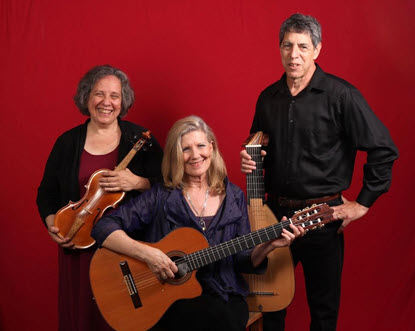
It’s September 23. I’m out of the country just now, producing a recording for a friend in the engineer’s living room, in an obscure little town near the famous town of Cognac in southwestern France. I come home next week and then fly to Hawai’i to play two concerts of Sephardic music on the Early Music Hawaii series, in late October, with Trio Sefardi.
It’s interesting, we’ve been invited to perform on an early-music series, but we can’t officially confirm that Sephardic music is “early music,” although some Romanza texts have been found in Medieval and Renaissance sources. Sephardic music has always been transmitted orally, and many tunes were only written down in the 20th century, collected by ethnomusicologists with tape recorders.
Early Music Hawaii still wants us to come, though. The new artistic director, Katherine Crosier, says they’d like a musical tour of the Sephardic Jews’ wanderings after being exiled from Spain in 1492, documenting the different kinds of Sephardic music from around the Mediterranean.
We’ll also perform Sephardic music written by 20th-century composers, including Trio Sefardi’s mentor, Bosnian musician Flory Jagoda, who lived in the former Yugoslavia until her family was forced to flee in WWII. She was 16 when they escaped. They had to go separately. Her father took the Jewish star off her coat, put her on a train to Split with her accordion and told her: Don’t talk, just sing and play all the Serbo-Croatian songs you know on your accordion. And that’s what she did. For four hours she played and sang and everyone in the train car sang with her, including the conductor, who never asked to see her ticket. She got to Split, then part of Italy, and was picked up at the station by their friends, and her parents arrived two weeks later.
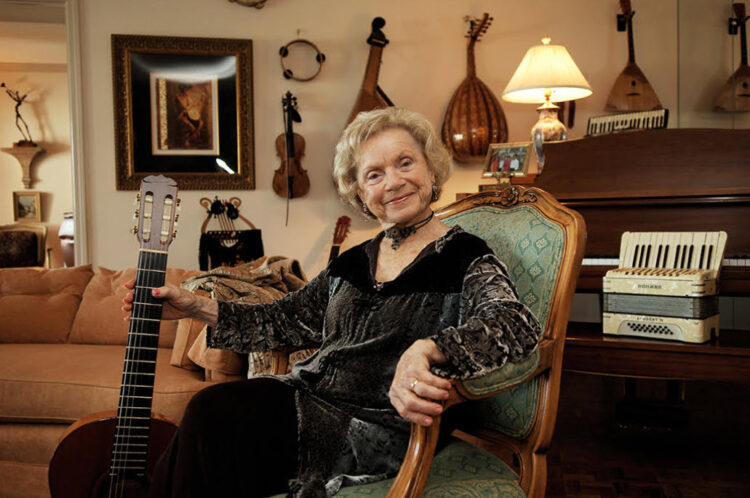
While she and her parents escaped, the other 42 members of their family were murdered and thrown into a pit in a field outside the village of Vlasenica. Flory’s mother was so traumatized that, for the 30 years until her death, Flory wasn’t allowed to speak a word of Ladino — the language of the Sephardic Jews, also known as Judaeo-Spanish — or sing any Ladino songs. Flory was 60 when her mother died, and only then did she begin to write songs in Ladino and perform them around Washington, D.C. with her adult children.
Flory’s first composition was “Ocho Kandelikas” (Eight Little Candles), a Hanukah song that’s still popular with musicians as diverse as Pink Martini and the United States Army Band “Pershing’s Own,” as well as with the members of hundreds of synagogues. Flory had a remarkable 30-year career, recording and touring the world, and was named a National Heritage Fellow in 2002 by the National Endowment for the Arts. The other two members of Trio Sefardi, Susan Gaeta and Howard Bass, toured with Flory for a dozen of those years, while I joined them for as many concerts as I could.
In a way, we are a tribute band, although we also sing Sephardic music from many times and places. And now we go to Hawai’i, to celebrate this living tradition with a new group of listeners. How great is that?
Tina Chancey is director of HESPERUS and a member of Trio Sefardi, Trio Pardessus, Passio, and the Chancey-Boekhoorn Duo. She plays early bowed strings, teaches, writes, and produces recordings, and so much more.