by The Ritchie Family
Published September 10, 2026
A memorial celebration of Stanley Ritchie’s life, combined with a Baroque Orchestra concert, is scheduled for Sunday, April 18, 2027, from 4-6 p.m. in Auer Hall at the Jacobs School of Music, IU Bloomington
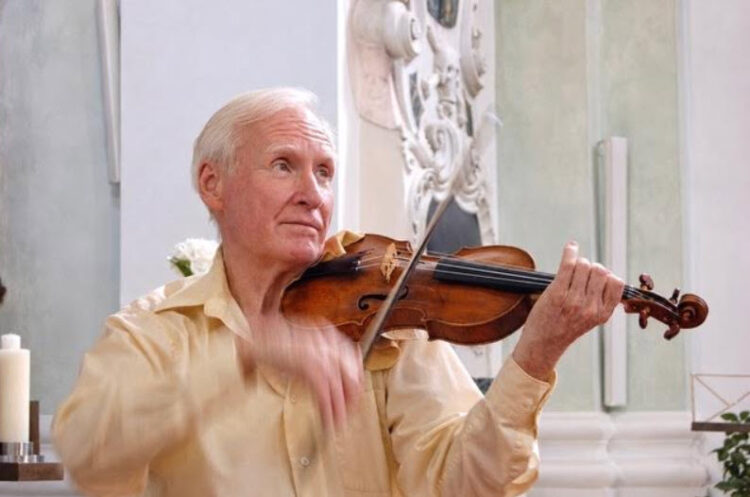
It is with the greatest sorrow that we announce the death of the eminent Australian violinist and pedagogue Stanley Ritchie, on Sunday, August 23, at the age of 91. A recipient of Early Music America’s Howard Mayer Brown Award for Lifetime Achievement in Early Music, Ritchie began teaching at Indiana University’s Jacobs School of Music, together with harpsichordist Elisabeth Wright, in 1982, thanks to the instigation of Thomas Binkley, founder of the Early Music Institute (later the Historical Performance Institute). They both retired from IU in 2021; Ritchie became Distinguished Professor Emeritus.
Ritchie was born in Yenda, a small rural town in New South Wales, Australia. In a 2012 interview with Violinist.com, he discussed his childhood education:
“When I was seven, my parents took me to the city (Sydney) for the first time and as we were walking down the street, I saw a violin in a shop window, I pointed at it and said, ‘I want that!’ They discussed it and said, ‘well, it is cheaper than a piano,’ so that was that! I took lessons at the local convent, the only place to take violin lessons. I had eight years of ladies — all but one of whom knew nothing at all about the violin!”
He then attended the Sydney Conservatorium of Music where the seed of his later fascination with early music was planted when, for a graduation exam, he had to answer the question, “What is meant by ‘style’ in music?” Following graduation in 1956, he received a scholarship to study with Jean Fournier in Paris, as part of a string quartet. Subsequently he went to the U.S. where he studied with Joseph Fuchs, Oscar Shumsky, and Samuel Kissel, took classes at Yale, and became a teaching assistant to Robert Koff at Brandeis University.
Prior to his reputation as a pioneer in the field of early music, he quickly established a distinguished career as modern-instrument violinist. In 1963, he served as concertmaster of the New York City Opera, then associate concertmaster of the Metropolitan Opera from 1965-70. In 1970 he joined the New York Chamber Soloists, where he first encountered harpsichordist Albert Fuller with whom he would later establish a summer festival and workshop at Aston Magna in Massachusetts. In 1973, he became assistant concertmaster of the Vancouver Symphony until 1975 when he became first violinist of the Philadelphia String Quartet, in residence at the University of Washington in Seattle.
His passion for Baroque music and period violin grew exponentially when he was in Vancouver, and it was there that he met harpsichordist Elisabeth Wright, recently back in the U.S. after three years of study in Amsterdam with Gustav Leonhardt, and in search of someone who played Baroque violin in the Pacific Northwest. They met, played Bach sonatas, and recognized their musical rapport which led to the formation of Duo Geminiani in 1974.
Together they concertized and gave masterclasses all over the world for over 40 years, earning critical acclaim for their recording of J.S. Bach’s Sonatas for violin and obbligato harpsichord. During their years in Seattle, they were leaders of the early-music movement, active with the Seattle Early Music Guild, and gave numerous concerts, inviting international artists and budding local specialists to join them.
Ritchie performed with many of the day’s most renowned early-music specialists, including Christopher Hogwood, Sir John Eliot Gardiner, Frans Brüggen, Roger Norrington, Joshua Rifkin, Malcolm Bilson, and Anner Bijlsma. He was a member of Three Parts Upon a Ground with violinists Andrew Manze, John Holloway, harpsichordist-organist John Toll, and lutenist Nigel North. He was also a member of The Mozartean Players, with cellist Myron Lutzke and fortepianist Steven Lubin, with whom he recorded Mozart and Schubert trios. He appeared as soloist or conductor with Academy of Ancient Music, Tafelmusik, Philharmonia Baroque Orchestra, and the Handel and Haydn Society Orchestra.
Ritchie served on the jury at the Leipzig International Bach Competition and was a frequent guest at Kloster Michaelstein in Blankenburg, Germany, where he gave masterclasses in Baroque and Classical technique and interpretation. He was faculty member of the Accademia di Musica Antica in Brunek (Südtirol) for over 20 years, and co-founder with Elisabeth Wright of BEMA (Bloomington Early Music Associates), the pre-cursor to BLEMF (Bloomington Early Music Festival) of which he was artistic director for ten years.
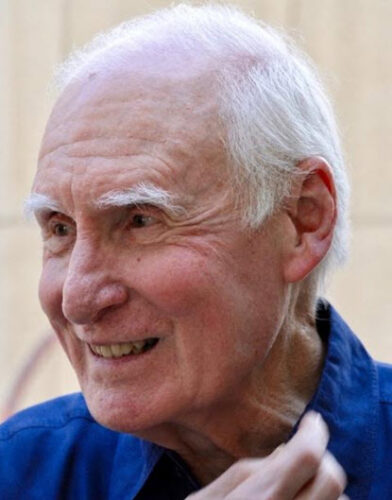
Ritchie taught generations of Baroque violinists and historical performance majors who now have flourishing international careers as performers and teachers, as well as numerous non-majors whose eyes were opened to a new way of looking at music, the instrument, and the printed page. His course ‘Interpreting unaccompanied Bach’ always had a waiting list.
Ritche wrote three books published by IU Press. Before the Chinrest – a Violinist’ s Guide to the Mysteries of Pre-Chin Technique and Style (2012); The Accompaniment in ‘Unaccompanied’ Bach: Interpreting the Sonatas and Partitas for Violin (2016), and, written after his retirement and published just this spring, Speaking Bach: Understanding the Language of the Sonatas and Partitas for Solo Violin (2026).
Of playing early music, Ritchie told Violinist.com that “It’s liberating, that’s one emotion I really experienced when I took up Baroque violin. After playing so many years professionally as a violinist, I found playing Baroque violin akin to driving a sports car! I felt physically liberated, and then eventually as I became more used to it, expressively liberated.”
After playing so many years professionally as a violinist, I found playing Baroque violin akin to driving a sports car!
His goal as a teacher was not to be dogmatic or create clones, but to share his love for the music, for the instrument, to inspire inquisitiveness and a desire to delve deeply into the context of the music, to ignite a student’s imagination and to give them the tools to enable them to express their own unique inner voice, freely. It is impossible to overstate the influence he has had on so many people or how beloved he was. Beyond the remarkable musician was a human being who never forgot his farm-boy roots, remained humble, charming, curious, passionate, kind, gentle, generous, witty, and his inner child was always in evidence!
From the famous Fat Nights to his incomparable ‘Stanhattans,’ having a good time was a priority! He never stopped wanting to learn new things whether it was foreign languages, drawing and painting, cooking, photography, and he enjoyed reading and observing all of nature’s creatures. In addition to loving all his generations of students, he was a devoted and loving father to his adored daughters, Jessica Ritchie, Robina Ritchie Barker, Alyson Ritchie Rinaldi, and a doting grandfather to his granddaughter, Arianna Rinaldi. We deeply mourn his loss but are so grateful that he had such a long, accomplished and rich life.
There will be a memorial celebration of his life, combined with a Baroque Orchestra concert on Sunday April 18th, 2027, from 4-6 p.m. in Auer Hall at the Jacobs School of Music, IU Bloomington.
— Elisabeth Wright, Professor Emerita of Early Keyboard, HPI Jacobs School of Music, IU Bloomington
(Portions of this article were first published in Laurie Niles’ Remembering Violinist Stanley Ritchie (1935-2026), Early Music Pioneer on Violin.com)