by Karen M. Cook
Published July 27, 2026
Video Game Review: Legends of the Round Table from Artifice Studios. Visual graphics led by Pierre Arrivé, music led by Anne Azéma.
King Arthur and his Round Table hold a particular pride of place in the modern imagination. The mythical king has been centered in fanciful constructions of ancient Britain since the ninth century, appearing in ever-new guises in subsequent histories, plays, operas, novels, films, cartoons, video games — and even baking flour — through the present day.
One of the most recent additions to this lofty lineage is Legends of the Round Table, a narrative role-playing and strategy video game released by Artifice Studio in March of this year. The music is performed by Anne Azéma (of Boston Camerata) and a cadre of well-known period instrumentalists. A litany of medieval pieces peppers the game’s sound world.
Here, the player leads the knights of the Round Table on dozens of quests adapted from (primarily French) Arthurian texts — famed stories such as the Green Knight, Tristan and Iseult, and the Bisclavret werewolf, beloved characters such as Kay, Ector, and Uther, Merlin, Gawain, Lancelot and, of course Arthur himself, and even the real-world Eleanor of Aquitaine, all feature prominently.
Azéma, as Eleanor, also acts as the game’s narrator, which makes for a delightful sense of continuity throughout.
The game is indebted to these fables, and to high medieval history, for its loosely assembled plot. It begins at the tomb of Eleanor of Aquitaine, whose spirit rises from her grave to set up one of the central themes of the game: the four virtues of love, prowess, largesse, and loyalty that comprise knighthood. Those are not merely themes, but central game mechanisms, and more shortly on that. Eleanor invites the player to look at, and relive, the tale of King Arthur. The player then steers Kay, Ector, and Arthur through London, eventually helping Arthur to pull the famed sword from the stone.
From there, the player chooses their path through numerous tournaments, quests, and battles, all derived from the vast wealth of Arthurian legends. The game makes every attempt to stay true to the lore while still also creating flexible choices and outcomes. Through dialogue, character design and deployment, battle decisions, and quest options, the player can shape and reshape these well-known tales. There is also an element of chance baked into the core of the gameplay; instead of dice, though, the game uses cards, one for each of the aforementioned virtues and a fifth grail (wild) card. Without giving too much away, the player will continue through these various Arthurian quests until they reach the final battle or until Arthur dies, at which point the game ends.
Certainly, other games (and media writ large) have reimagined these tales for centuries. This game, however, stands out from the crowd for two significant reasons: its art and its sound.
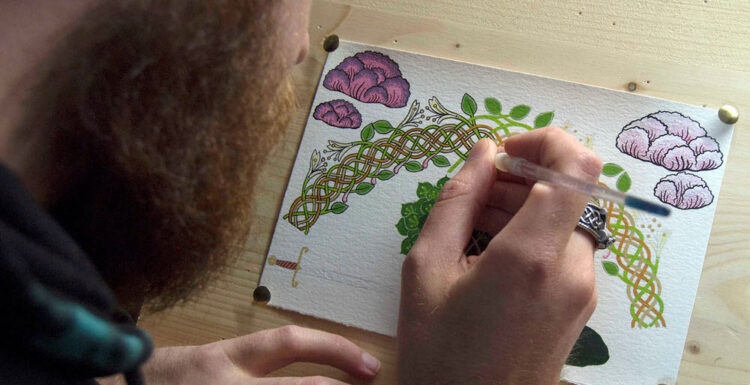
The game is gorgeously hand-drawn, just like a medieval manuscript. Several recent games have also been inspired by medieval illuminations — Obsidian’s Pentiment (2022, medieval music performed by Alkemie), or Yaza Games’s Inkulinati (2024, music by composer Aleksander Zablocki) and Scriptorium (2026, music by Jake Gaule) — but Legends, I think, takes the crown. The primary artist behind the game’s graphics, Pierre Arrivé, is an illuminator who hand-drew every visual element in the game using only illumination techniques and color choices true to the 13th century. The game itself is even set within the very book Eleanor shows us at the start of the game: the pages turn for every year, and the action takes place within an illuminated panel on a given page.
The sound design is more than a match for the graphics. Music grounds the game from the start; the loading scene features Azéma, accompanied by a gittern, singing the Comtessa de Dia’s “Ab joi et ab joven m’apais,” and we hear a plucked harp melody, a church bell, plainchant, and female song all before the player ever takes the controls. Vielles, harps, and recorders play during loading scenes; ceremonial trumpets blast and percussion rumbles during tournaments and battles; and the Dies Irae solemnly intones should a prominent member of your party (no spoilers here) die in battle.
In addition to the Comtessa’s canso, the attentive player might note melodies borrowed from the Cantigas de Santa Maria (“Santa Maria, strela do dia,” for example), or an estampie on shawms, or a rendition of Guillame de Machaut’s well-known “Douce dame jolie” on flute. Furthermore, medieval-inspired melodies occasionally grace the newly written game text, allowing Azéma to half-speak, half-sing the game’s narration at significant moments in the story. The period instruments and choices in music thus work hand-in-hand with the visuals and the plot to cement the game in medieval Arthurian legend.
The music has, in fact, created quite a buzz among the game’s players. In reviews and discussion boards alike, players have praised the music for its authenticity, beauty, persuasion, and absorption. While unfortunately there is no official published list of the tracks included in the game, nor is there an official soundtrack, players in the Steam discussion boards have clamored for the soundtrack to be published or released as downloadable content.
Given the penchant for Azéma and the Boston Camerata to present a highly programmed, narrated concert event — indeed, this style of performance is what led Artifice Studio to approach her in the first place — I could only imagine how successful a concert hybrid, half medieval music and Arthurian tales, half Legends (complete with game clips on screen) would be. Perhaps the Camerata might be compelled to join the video-game concert circuit? Or, even more intriguing, present game clips at a more traditional “early music” concert? One can only hope!
The attention to detail that the game developers, Azéma, and the instrumentalists have given to the music in this game is remarkable. The ways in which the various songs, chants, and dances have been shaped to support the text and the overall plot, the care given to ensuring the music also meshes nicely with the game mechanics, and the extraordinary quality of the performance itself, both music and narration, all combine to create an incredibly absorbing game experience. Musically speaking, a highly recommended adventure.
Karen M. Cook is associate professor of music history at the University of Hartford. She specializes in late-medieval music theory and notation, focusing on developments in rhythmic duration. She also maintains a primary interest in musical medievalism in contemporary media, particularly video games. For EMA, she recently wrote about Wailing Women and Italian Convents.