by Anna Mansbridge
Published November 16, 2026
Haydn’s Minuets and Eighteenth-Century Dance by Joseph Fort, Cambridge University Press, 2025. 228 pages.
Joseph Fort breaks down the minuet step in a way that is accessible for non-dancers to understand, and encourages the reader to take the time to practice the step
The minuet was often referred to in the 18th century as “the Queen of Dances” and was a favorite dance in Europe for about 150 years. Originating at the aristocratic Court of Louis XIV during the 1660s, it was still a popular dance in Vienna at the end of the 18th century. Joseph Fort, organist and director of the Chapel Choir, and lecturer in music at King’s College, London, has written in his thought-provoking book that knowing how to dance a minuet, as described in historical sources, enriches the listener’s appreciation of the music.
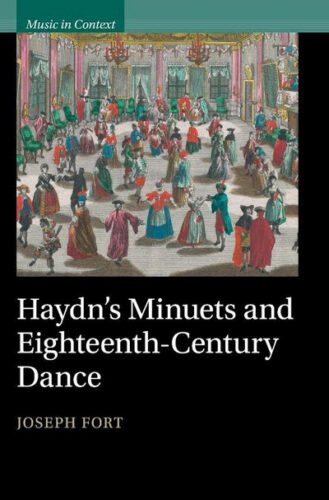
As a Baroque dance practitioner, I have for many years been reconstructing and performing minuets using the Beauchamp-Feuillet notation system, a method first published in France in 1700 using abstract symbols to write down dance choreography. Because of this, I cannot help but engage with the music through a kinesthetic sense of step. I was therefore very interested to read Fort’s book, which places somatic inquiry (physical, bodily sensations) at the center of musical appreciation, specifically Haydn’s minuets.
Fort begins by exploring the historical context of the dancing culture in late 18th-century Vienna, explaining the social and political changes that gave rise to the popularity of public balls, as distinct from the carefully regulated private balls of the royal courts, such as the King’s Grand Ball, as described by Pierre Rameau in The Dancing Master from 1725. Fort explains how, in “Dancing Mad” Vienna, the minuet was a central feature of the Redoute, which was a public ball open to members of the public from different classes of society for the price of a ticket. Many attendees wore masks and costumes that helped to conceal their identity, adding an air of mystery and secrecy, which encouraged people to interact across different social classes.
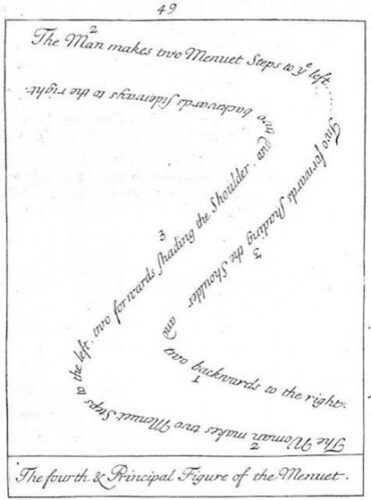
The Z figure (used in the minuet) as illustrated in John Essex’s 1728 ‘The Dancing Master,’ based on Pierre Rameau’s 1725 book (Courtesy Cambridge Univ. Press)
Fort conjures up one particular night, November 25, 1792, when a ball had been organized by the Gesellschaft bildender Künstler (Society of Visual Artists) to raise funds for “aging and ailing artists.” He imagines the scene that would have greeted the attendees: the brilliance of the lighting, the heat in the room, the sounds from the orchestra, and the sight of graceful couples performing either the minuet or the German dance. Joseph Haydn wrote 12 minuets specifically for this ball, a task that he often undertook for social events. The fact that Haydn composed over 400 minuets particularly for dancing demonstrates his creativity, imagination, and inventiveness. Minuets played one after the other at a public ball had to sound distinctive and be inspiring to dance to, otherwise people might get bored and leave the dance floor!
After discussing the key role that dancing played in social life in 18th-century Vienna, Fort then takes us on a fascinating journey of exploration and discovery of the minuet through somatic inquiry. This encourages the reader to get up and dance and feel for themselves the transformative experience of embodying the steps and spatial patterning of the ballroom minuet. Fort identifies the original ballroom minuet as chiefly a theatrical dance as it was performed by one couple at a time in front of an audience, in contrast to the end of the 18th century when it became a group dance performed by many couples at the same time.
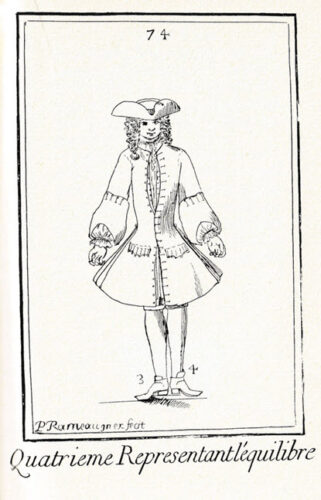
Image from Pierre Rameau’s ‘Le maître à dancer,’ an important source for performance practice from 1725 (Courtesy Cambridge Univ. Press)
There are various ways to dance a minuet step, as explained by different dancing masters during the 18th century. Fort pays special attention to the explanation by Carl Joseph von Feldtenstein in 1772 because it was the most popular (and incidentally the same as that described by the English dancing master Kellom Tomlinson in 1735). Fort breaks down the minuet step in a way that is accessible for non-dancers to understand, and encourages the reader to take the time to practice the step so that it becomes familiar. He explains how the minuet step comprises four steps that fit into two bars of music. Rhythmic articulation is achieved through the bending and rising that takes place during these four steps across the six-crotchet pulse of the two-bar cell. The carriage of the body when dancing a minuet has a noble and dignified bearing, emphasizing the verticality of the spine, while allowing for a slight turn of the head and graceful gestures of the arms and hands.
Once familiarity with the minuet step has been established, Fort then asks the central question, “What does it mean to dance the minuet?” This is a personal and subjective approach to analysis, as Fort acknowledges, because the experience of dancing the minuet will not be the same for all bodies. My kinesthetic experience of dancing a minuet sometimes differs from that described by Fort. However, by reflecting on his own realization of dancing to Haydn’s Minuet No. 1 in D Major (Hob. IX:11, No.1), and other symphonic minuets, he does demonstrate the “bodily sensation of motion being crucial to the musical experience” and makes a “direct link between felt motion and the pleasure of a listening experience.” I hope that people reading this book will discover for themselves the rich musical joyfulness of Haydn’s minuets through dancing.
Anna Mansbridge is a freelance dancer, teacher, and choreographer living in Seattle. Originally from Australia and the U.K., she has been a Baroque dance practitioner for 40 years. She was profiled in the May 2026 issue of EMAg, the Magazine of Early Music America.