by Andrew Sammut
Published August 24, 2026
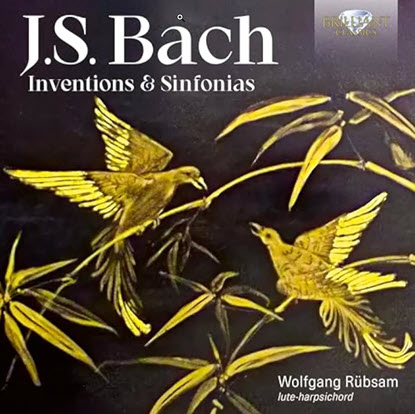
J.S. Bach: Inventions & Sinfonias. Wolfgang Rübsam, lautenwerk. Brilliant Classics 97684
Bach first composed the Inventions as keyboard exercises in two voices for his son Wilhelm Friedemann Bach during his time in Köthen, around 1720. He probably completed the three-part Sinfonias shortly after he settled in Leipzig, roughly 1723. The complete set of 30 instructional pieces wasn’t published in his lifetime, but it circulated widely and is now a staple of piano lessons. Those teacherly associations may be part of the reason for its modest representation on recordings compared to Bach’s other works. Yet Bach being Bach, even in pedagogical mode, he wrote music capable of far more.
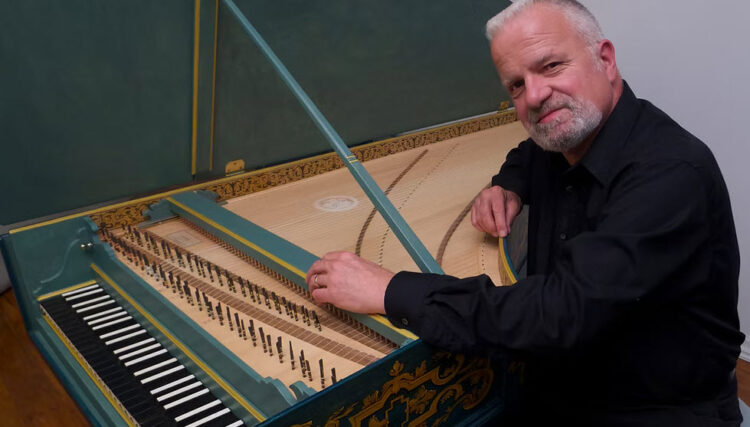
In addition to an extensive discography, Wolfgang Rübsam also has a lengthy CV teaching in the United States and Germany. Maybe that’s why he has such an affinity for this “didactic” music. This is Rübsam’s second recording of the Inventions and Sinfonias, following his Naxos disc over 30 years ago on a Bösendorfer modern grand piano. He not only returns on a period instrument but has also selected a rarely heard one.
Compared to the harpsichord, with its tightly strung metal strings, the gut-stringed lautenwerk has a relatively softer timbre and more sustain. Bach enjoyed playing the “lute-harpsichord” so much that he owned two. Yet there are no surviving models. Contemporary instrument makers such as Keith Hill, Willard Martin, and Steven Sorli have nonetheless helped revive the instrument. Recently, it looks like it might even be having a mini resurgence on record. (For Early Music America, harpsichordist Andrew Appel recently reviewed Charlotte Mattax Moersch’s second disc of Bach transcriptions performed on a lautenwerk.)
Now Rübsam has recorded Bach on lautenwerk, describing it as “the perfect instrument” on his website. He’s also discussed the importance of the “cantabile” style in Bach’s music: not just in terms of smoothness but — like singers enunciating the lyrics — absolute clarity of contrapuntal lines and themes. Elsewhere, he describes how Bach’s music must be “unpredictable” even as the listener hears every polyphonic nuance. Those musical priorities are obvious on this disc.
Rübsam’s precise touch and rhythm shed light on every note. Ruminative tempos and rubato ensure things rarely settle into a steady pulse or flow in expected directions. The Invention in C is the first and probably best-known piece in this set. Yet if you’d never heard it or a lautenwerk before, you might think you were listening to two lutenists so well-versed in Bach’s language that they were improvising “Dueling Bach.” Similarly, the Sinfonia in E-flat is more like an airy chamber trio than a keyboard solo in three voices.
A sense of rhetorical pacing, often stressed in Baroque music, is also apparent throughout the recital. The cresting phrases and bright intervals of the C-minor Sinfonia are as much gestures for emphasis as parts of Bach’s structure. Ornamentation, beyond trills or decorating da capos, is another of Rübsam’s priorities. He adds plenty of his own touches in addition to using ornamented versions of several movements by one of Bach’s students.
Rübsam achieves utter transparency and avoids predictability but, at times, the spaciousness and note-by-note flow might feel overdone to some listeners. The C-minor Invention could seem introspective to the point of hesitancy with Rübsam’s meticulous articulation and liberal time. He almost stretches the coy theme of the B-minor Invention into a rhapsody. On the other hand, the repeated notes and double-time outbursts in the B-minor Sinfonia assume an anguished character under his freer approach. In movements like the D-minor Invention, the sheer clarity of lines opens into a charmingly dark little story.
The particular choice of lautenwerk plays a significant role. The single-manual instrument by Keith Hill enables a range of colors, from an open, buttery sound to a harpsichord-like ring. (Hill wrote an essay describing the instrument.) Sympathetic strings add resonance and sweetness across its entire range. The left hand’s descending notes in the second phrase of the E-Major Invention are especially rich and clear. The grain in the D-Major Invention might convince even the instrument’s skeptics. The G-minor Invention showcases both part separation and the match between a soloist and their instrument. Rübsam is also the recording engineer, capturing enough of the reverberating acoustic inside Minneapolis’ Saint Helena Catholic Church while keeping the sound clean.
Commentators have discussed a supposed tension between these works’ pedagogical purpose and their formal beauty. Rübsam’s reading is like an X-ray into this music, providing both an education and a deeply musical, if idiosyncratic, addition to the catalog.
Andrew J. Sammut covers music for Early Music America, the Syncopated Times, Vintage Jazz Mart, and his blog, the Pop of Yestercentury. He has also written for All About Jazz, Boston Classical Review, and Boston Musical Intelligencer. For EMA, he recently reviewed viola da gamba player Caroline Nicholas’ Pièces en Solitude.